Pearson+ LogoPearson+ Logo
Ch. 48 - The Immune System in Animals
Freeman - Biological Science 7th Edition
Freeman7th EditionBiological ScienceISBN: 9783584863285Not the one you use?Change textbook
Chapter 48, Problem 13

<Image>
In developed countries, an enormous change has occurred within the human body over the past century—the loss of parasitic worms. Due to improvements in sanitation, roundworms that have inhabited human intestines (such as the hookworm above) and challenged our immune system for millions of years are no longer a threat. Does the end of this long-term relationship come at a cost?
Pattern-recognition receptors have been identified that recognize worm products. Explain how these receptors are used to activate the adaptive immune response most appropriate for worm infection.

Verified step by step guidance
1
Pattern-recognition receptors (PRRs) are a crucial part of the innate immune system. They identify pathogen-associated molecular patterns (PAMPs) present on parasitic worms.
When PRRs recognize worm products, they trigger an initial immune response, which includes the activation of innate immune cells such as macrophages and dendritic cells.
Dendritic cells, once activated, process and present antigens from the worms on their surface using major histocompatibility complex (MHC) molecules.
These antigen-presenting cells then migrate to lymph nodes, where they interact with T cells, specifically helper T cells (Th2), which are crucial for the adaptive immune response against parasitic worms.
The activated Th2 cells release cytokines that stimulate B cells to produce antibodies, particularly IgE, and recruit other immune cells like eosinophils and mast cells, which are effective in combating worm infections.

Verified video answer for a similar problem:

This video solution was recommended by our tutors as helpful for the problem above.
Video duration:
1m
Was this helpful?

Key Concepts

Here are the essential concepts you must grasp in order to answer the question correctly.

Pattern-recognition receptors (PRRs)

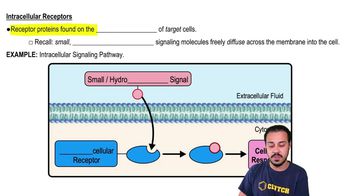
Pattern-recognition receptors are proteins on or in cells that recognize specific molecular patterns associated with pathogens, such as parasitic worms. These receptors play a crucial role in the innate immune system by detecting foreign invaders and initiating an immune response. PRRs identify worm products, triggering signaling pathways that lead to the activation of immune cells and the production of cytokines, which help coordinate the body's defense mechanisms.
Recommended video:
Guided course
02:28
Intracellular Receptors

Adaptive immune response

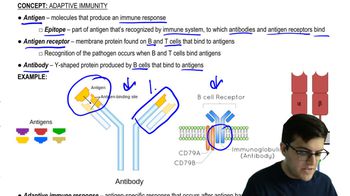
The adaptive immune response is a specialized defense mechanism that targets specific pathogens with precision. Upon activation by signals from the innate immune system, such as those from PRRs, adaptive immunity involves the proliferation of lymphocytes—B cells and T cells—that recognize and remember specific antigens. This response is tailored to effectively combat worm infections by producing antibodies and activating immune cells that can directly attack or neutralize the parasites.
Recommended video:
Guided course
05:50
Adaptive Immune Response

Immune system adaptation to parasitic worms

The human immune system has evolved to manage parasitic worm infections through a complex interplay between innate and adaptive responses. Historically, the presence of worms has shaped immune function, promoting tolerance and regulation to prevent excessive inflammation. The loss of these parasites in developed countries may impact immune regulation, potentially leading to increased susceptibility to autoimmune diseases, as the immune system may become overly reactive without the modulatory influence of worms.
Recommended video:
Guided course
05:50
Adaptive Immune Response
Related Practice
Textbook Question

Propose a hypothesis to explain how self-reactive B cells are identified and eliminated during maturation.

614
views
Textbook Question

<Image>

In developed countries, an enormous change has occurred within the human body over the past century—the loss of parasitic worms. Due to improvements in sanitation, roundworms that have inhabited human intestines (such as the hookworm above) and challenged our immune system for millions of years are no longer a threat. Does the end of this long-term relationship come at a cost?

What is the hygiene hypothesis? What correlation does it attempt to explain?

762
views
Textbook Question

<Image>

In developed countries, an enormous change has occurred within the human body over the past century—the loss of parasitic worms. Due to improvements in sanitation, roundworms that have inhabited human intestines (such as the hookworm above) and challenged our immune system for millions of years are no longer a threat. Does the end of this long-term relationship come at a cost?

Explain how the adaptive and innate immune responses work together to defend the human body against infection by parasitic worms.

878
views
Textbook Question

<Image>

In developed countries, an enormous change has occurred within the human body over the past century—the loss of parasitic worms. Due to improvements in sanitation, roundworms that have inhabited human intestines (such as the hookworm above) and challenged our immune system for millions of years are no longer a threat. Does the end of this long-term relationship come at a cost?

Parasitic worms modulate their host's immune response by inducing the proliferation of regulatory T cells. What role do these cells play in the adaptive immune response? How could this effect on regulatory T cells be linked to the hygiene hypothesis?

733
views
Textbook Question

<Image>

In developed countries, an enormous change has occurred within the human body over the past century—the loss of parasitic worms. Due to improvements in sanitation, roundworms that have inhabited human intestines (such as the hookworm above) and challenged our immune system for millions of years are no longer a threat. Does the end of this long-term relationship come at a cost?

The roundworm Heligmosomoides polygyrus is a natural intestinal parasite of mice, and it offers an excellent model of the immunology of worm infections in humans. Scientists evaluated the impact of parasitic roundworms on immune disorders using mice prone to developing type 1 diabetes mellitus. Five-week-old mice were infected with H. polygyrus (Hp). Two weeks later, half of the mice were cured of the infection (Rx). When the mice were 40 weeks old, scientists calculated the percentage of mice that developed diabetes in both groups: those exposed to roundworms and those in uninfected control groups (** means P<0.01). What two conclusions are supported by the results shown below?

825
views
Textbook Question

<Image>

In developed countries, an enormous change has occurred within the human body over the past century—the loss of parasitic worms. Due to improvements in sanitation, roundworms that have inhabited human intestines (such as the hookworm above) and challenged our immune system for millions of years are no longer a threat. Does the end of this long-term relationship come at a cost?

There is a strong association between the prevalence of diabetes mellitus in parents and their children. If you were a physician, would you ask parents who have type 1 diabetes to intentionally infect their children with intestinal worms? What additional information would you need to make this decision?

946
views