Skip to main content
Statistics for Business
My Course
Learn
Exam Prep
AI Tutor
Study Guides
Flashcards
Explore
Try the app
My Course
Learn
Exam Prep
AI Tutor
Study Guides
Flashcards
Explore
Try the app
Back
Bar Graphs and Pareto Charts quiz
You can tap to flip the card.
What type of data are bar graphs best suited for displaying?
You can tap to flip the card.
👆
What type of data are bar graphs best suited for displaying?
Bar graphs are best suited for displaying categorical or qualitative data.
Track progress
Control buttons has been changed to "navigation" mode.
1/15
Related flashcards
Related practice
Recommended videos
Bar Graphs and Pareto Charts definitions
Bar Graphs and Pareto Charts
15 Terms
Bar Graphs and Pareto Charts
2. Describing Data with Tables and Graphs
10 problems
Topic
Ernest
Pie Charts
2. Describing Data with Tables and Graphs
10 problems
Topic
Ally
2. Describing Data with Tables and Graphs
10 topics
15 problems
Chapter
David-Paige
Guided course
04:52
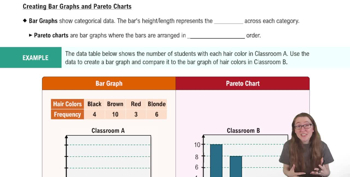
Creating Bar Graphs and Pareto Charts
368
views
8
rank
Guided course
05:26
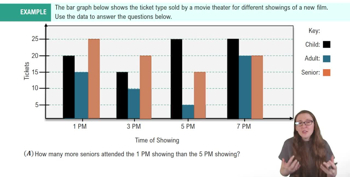
Example 1
252
views
16
rank
Terms in this set (15)
Hide definitions
What type of data are bar graphs best suited for displaying?
Bar graphs are best suited for displaying categorical or qualitative data.
On a typical vertical bar graph, which axis displays the categories?
The x-axis typically displays the categories on a vertical bar graph.
What does the height of each bar in a bar graph represent?
The height of each bar represents the frequency of that category.
What is a Pareto chart?
A Pareto chart is a special bar graph where bars are arranged in descending order of frequency.
Why are Pareto charts useful for data analysis?
Pareto charts make it easy to identify the most and least common categories by arranging bars from tallest to shortest.
How do you determine the scale for the y-axis when creating a bar graph?
Choose a scale that covers the minimum and maximum frequencies in your data, allowing all bars to fit clearly.
If a bar graph has categories black, brown, red, and blonde, and their frequencies are 4, 10, 3, and 6, how many bars will the graph have?
The bar graph will have four bars, one for each hair color category.
How can you compare the number of students with a certain hair color between two classrooms using bar graphs?
Compare the heights of the bars for that hair color in each classroom's bar graph.
What is the main visual difference between a standard bar graph and a Pareto chart?
In a Pareto chart, the bars are arranged from tallest to shortest, while in a standard bar graph, they may follow the order in the data table.
If Classroom A has a brown hair bar of height 10 and Classroom B has a brown hair bar of height 4, which classroom has more students with brown hair?
Classroom A has more students with brown hair because its bar is taller (10 vs. 4).
How do you find the difference in frequency for a category between two bar graphs?
Subtract the smaller bar's height from the larger bar's height for that category.
What should you do if your y-axis is not already scaled when creating a bar graph?
You should choose and label a scale that fits all your data frequencies.
Is it acceptable to place categories on the y-axis and have horizontal bars in a bar graph?
Yes, it is acceptable, but it is much less common than using vertical bars.
What is the purpose of shading in the bars of a bar graph?
Shading helps make the bars more visible and easier to distinguish.
What is the first step in creating a bar graph from a data table?
The first step is to identify the categories and their frequencies from the data table.
 BackBack


 04:52
04:52