Skip to main content
Statistics for Business
My Course
Learn
Exam Prep
AI Tutor
Study Guides
Flashcards
Explore
Try the app
My Course
Learn
Exam Prep
AI Tutor
Study Guides
Flashcards
Explore
Try the app
Back
Frequency Distributions definitions
You can tap to flip the card.
Frequency Distribution
You can tap to flip the card.
👆
Frequency Distribution
A table organizing the number of measurements within specified groups or categories, aiding in data analysis.
Track progress
Control buttons has been changed to "navigation" mode.
1/15
Related flashcards
Related practice
Recommended videos
Frequency Distributions quiz
Frequency Distributions
15 Terms
Frequency Distributions
2. Describing Data with Tables and Graphs
10 problems
Topic
Justin
Histograms
2. Describing Data with Tables and Graphs
10 problems
Topic
Jonathan
2. Describing Data with Tables and Graphs
10 topics
15 problems
Chapter
David-Paige
Guided course
06:19
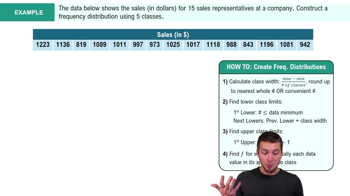
Intro to Frequency Distributions Example 1
429
views
23
rank
Guided course
05:18
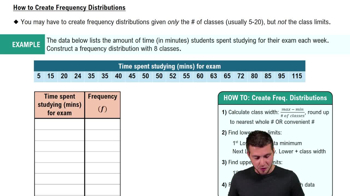
How to Create Frequency Distributions Example 2
357
views
9
rank
Guided course
06:29
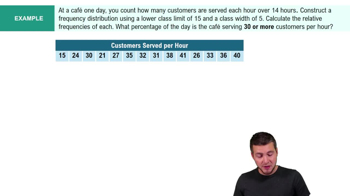
How to Create Frequency Distributions
438
views
15
rank
Terms in this set (15)
Hide definitions
Frequency Distribution
A table organizing the number of measurements within specified groups or categories, aiding in data analysis.
Class
A group or interval used to categorize data values within a frequency distribution.
Lower Class Limit
The smallest value that can belong to a particular group in a frequency distribution.
Upper Class Limit
The largest value that can belong to a particular group in a frequency distribution.
Class Width
The difference between consecutive lower or upper class limits, often rounded for convenience.
Class Midpoint
The average of the lower and upper boundaries of a group, representing its center value.
Relative Frequency
The proportion or percentage of data values falling within a group compared to the total number.
Tally
A counting method used to keep track of the number of data values in each group before finalizing totals.
Interval
A continuous range of values defining the boundaries of a group in a frequency distribution.
Data Set
A collection of individual measurements or values to be organized and analyzed.
Measurement
A single observed value within a data set, assigned to a group in a frequency distribution.
Percent
A way to express relative frequency, showing the proportion of data in a group out of 100.
Table
A structured arrangement of data, often used to display frequency distributions for clarity.
Maximum
The largest value present in a data set, used to determine group boundaries.
Minimum
The smallest value present in a data set, used to determine group boundaries.
 BackBack


 06:19
06:19