Skip to main content
Statistics for Business
My Course
Learn
Exam Prep
AI Tutor
Study Guides
Flashcards
Explore
Try the app
My Course
Learn
Exam Prep
AI Tutor
Study Guides
Flashcards
Explore
Try the app
Back
Hypothesis Tests for Correlation Coefficient Using TI-85 definitions
You can tap to flip the card.
Correlation Coefficient
You can tap to flip the card.
👆
Correlation Coefficient
A numerical measure indicating the strength and direction of a linear relationship between two variables in a dataset.
Track progress
Control buttons has been changed to "navigation" mode.
1/15
Related flashcards
Related practice
Recommended videos
Hypothesis Tests for Correlation Coefficient Using TI-85 quiz
Hypothesis Tests for Correlation Coefficient Using TI-85
15 Terms
11. Correlation
2 topics
15 problems
Chapter
David-Paige
Guided course
05:28
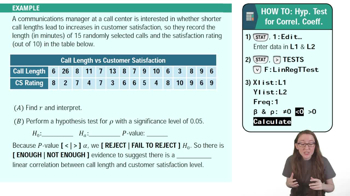
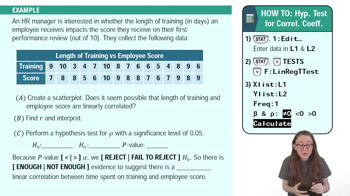
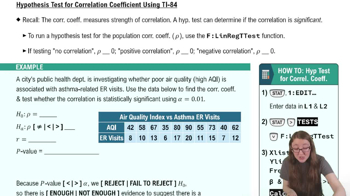
Hypothesis Tests for Correlation Coefficient Using TI-84
106
views
Guided course
03:35
Hypothesis Tests for Correlation Coefficient Using TI-84 Example 1
73
views
1
rank
Guided course
06:24
Hypothesis Tests for Correlation Coefficient Using TI-84 Example 2
74
views
1
rank
Terms in this set (15)
Hide definitions
Correlation Coefficient
A numerical measure indicating the strength and direction of a linear relationship between two variables in a dataset.
Population Correlation Coefficient
A parameter representing the true linear association between two variables for an entire population, often denoted by the Greek letter rho.
Null Hypothesis
A statistical assumption stating there is no linear correlation between two variables, typically represented as rho equals zero.
Alternative Hypothesis
A statistical claim suggesting a linear correlation exists between two variables, often expressed as rho not equal to zero.
Alpha Level
A threshold probability, such as 0.01, used to determine statistical significance and the likelihood of rejecting the null hypothesis.
P-value
A calculated probability indicating the strength of evidence against the null hypothesis in a statistical test.
Statistical Significance
A condition where observed data provides enough evidence to reject the null hypothesis, implying a real effect or association.
Linear Correlation
A relationship where changes in one variable are associated with proportional changes in another variable, forming a straight-line pattern.
LinReg t-Test
A calculator function used to test hypotheses about the population correlation coefficient using sample data.
Sample Data
A subset of observations collected from a population, used to estimate and test relationships between variables.
Directional Correlation
A specific type of alternative hypothesis focusing on whether the association between variables is positive or negative.
Inferential Statistics
A branch of statistics that draws conclusions about populations based on sample data analysis.
Predictive Analytics
A statistical approach using data and models to forecast future outcomes or trends based on observed relationships.
Test Menu
A calculator interface section where statistical tests, such as the LinReg t-Test, are selected and executed.
Frequency
A setting in statistical software indicating how often each data point occurs, typically set to one for unique entries.
 BackBack
 05:28
05:28