Skip to main content
Statistics for Business
My Course
Learn
Exam Prep
AI Tutor
Study Guides
Flashcards
Explore
Try the app
My Course
Learn
Exam Prep
AI Tutor
Study Guides
Flashcards
Explore
Try the app
Back
Independence Test Using TI-84 definitions
You can tap to flip the card.
Chi-Square Test
You can tap to flip the card.
👆
Chi-Square Test
A statistical method comparing observed and expected frequencies to assess association between categorical variables.
Track progress
Control buttons has been changed to "navigation" mode.
1/15
Related flashcards
Related practice
Recommended videos
Independence Test Using TI-84 quiz
Independence Test Using TI-84
15 Terms
13. Chi-Square Tests & Goodness of Fit
3 topics
15 problems
Chapter
Brendan
Guided course
04:20
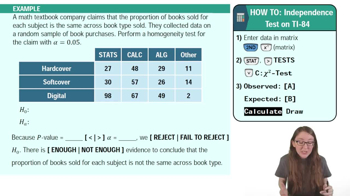
Independence Test Using TI-84
96
views
Guided course
04:03
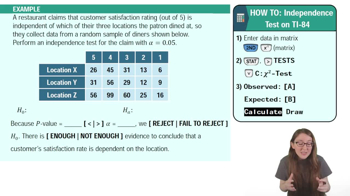
Independence Test Using TI-84 Example 2
63
views
Guided course
02:23
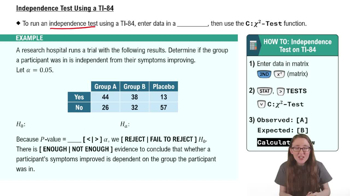
Independence Test Using TI-84 Example 1
57
views
Terms in this set (15)
Hide definitions
Chi-Square Test
A statistical method comparing observed and expected frequencies to assess association between categorical variables.
Independence Test
A procedure used to determine if two categorical variables are unrelated within a population.
TI-84
A graphing calculator model equipped with statistical functions for analyzing data, including matrix operations.
Matrix
A rectangular array used to organize and input categorical data for statistical analysis on calculators.
Observed Frequencies
The actual counts collected from data, representing how often each category combination occurs.
Expected Frequencies
The calculated counts predicting how often each category combination should occur if variables are independent.
Null Hypothesis
A statement proposing no association exists between variables, serving as the default assumption in tests.
Alternative Hypothesis
A statement suggesting a relationship or dependence exists between variables under investigation.
P-Value
A probability measure indicating the strength of evidence against the null hypothesis in statistical tests.
Alpha Level
A threshold probability, such as 0.05, used to decide whether to reject the null hypothesis.
Homogeneity Test
A statistical procedure comparing distributions across groups to check if they are similar or different.
Statistical Inference
The process of drawing conclusions about populations based on sample data analysis.
Test Menu
A calculator interface section where statistical tests, including the chi-square test, are accessed.
Matrix Menu
A calculator interface section for creating, editing, and managing matrices for data input.
Conclusion
The final interpretation of test results, indicating whether evidence supports dependence or independence.
 BackBack
 04:20
04:20