Skip to main content
Statistics for Business
My Course
Learn
Exam Prep
AI Tutor
Study Guides
Flashcards
Explore
Try the app
My Course
Learn
Exam Prep
AI Tutor
Study Guides
Flashcards
Explore
Try the app
Back
Independence Test Using TI-84 quiz
You can tap to flip the card.
What is the first step when performing a chi-square test of independence on a TI-84 calculator?
You can tap to flip the card.
👆
What is the first step when performing a chi-square test of independence on a TI-84 calculator?
The first step is to enter your categorical data as a matrix in the calculator.
Track progress
Control buttons has been changed to "navigation" mode.
1/15
Related flashcards
Related practice
Recommended videos
Independence Test Using TI-84 definitions
Independence Test Using TI-84
15 Terms
13. Chi-Square Tests & Goodness of Fit
3 topics
15 problems
Chapter
Brendan
Guided course
04:20
Independence Test Using TI-84
96
views
Guided course
04:03
Independence Test Using TI-84 Example 2
63
views
Guided course
02:23
Independence Test Using TI-84 Example 1
57
views
Terms in this set (15)
Hide definitions
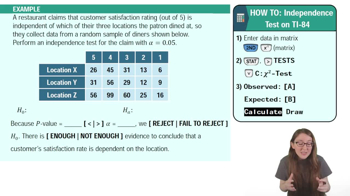
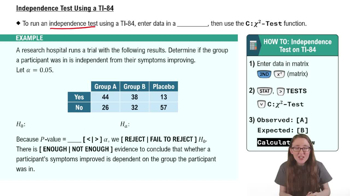
What is the first step when performing a chi-square test of independence on a TI-84 calculator?
The first step is to enter your categorical data as a matrix in the calculator.
How do you access the matrix menu on a TI-84 calculator?
Press the 'second' button and then the 'x^-1' button, which has 'matrix' above it.
What should you do after entering your data into a matrix on the TI-84?
After entering your data, you should access the 'stat' button, scroll to the 'test' menu, and select the chi-square test function.
Which matrix should contain your observed frequencies when running a chi-square test on the TI-84?
Matrix A should contain your observed frequencies, as that's where you entered your data.
What does the TI-84 calculator do with the expected frequencies during a chi-square test?
The calculator automatically calculates the expected frequencies and stores them in a different matrix, such as Matrix B.
What is the null hypothesis in a chi-square test of independence?
The null hypothesis states that the variables are independent of each other.
What is the alternative hypothesis in a chi-square test of independence?
The alternative hypothesis states that the variables are dependent on each other.
How do you determine whether to reject the null hypothesis in a chi-square test using the TI-84?
Compare the p-value to the alpha level; if the p-value is less than alpha, reject the null hypothesis.
What does a p-value smaller than the alpha level indicate in a chi-square test of independence?
It indicates that there is enough evidence to conclude the variables are dependent.
What is the typical alpha level used in chi-square tests of independence?
A typical alpha level is 0.05.
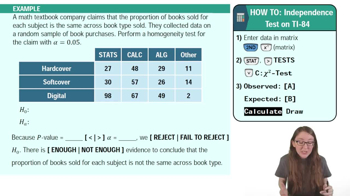
How are homogeneity tests similar to independence tests on the TI-84?
They use the same steps on the calculator, but the hypotheses and conclusions are worded differently.
What must you adjust when performing a homogeneity test instead of an independence test?
You must adjust the wording of the hypotheses and the conclusion.
What is the purpose of the chi-square test function on the TI-84?
It compares observed and expected frequencies to test for independence or homogeneity between categorical variables.
Why is it important to use a different matrix for expected frequencies than for observed frequencies on the TI-84?
Using a different matrix prevents overwriting your original data and allows the calculator to store expected values separately.
What is the conclusion if the p-value is 1.7 x 10^-7 and the alpha is 0.05 in a chi-square test?
Since the p-value is much smaller than alpha, you reject the null hypothesis and conclude the variables are dependent.
 BackBack
 04:20
04:20