Skip to main content
Statistics for Business
My Course
Learn
Exam Prep
AI Tutor
Study Guides
Flashcards
Explore
Try the app
My Course
Learn
Exam Prep
AI Tutor
Study Guides
Flashcards
Explore
Try the app
Back
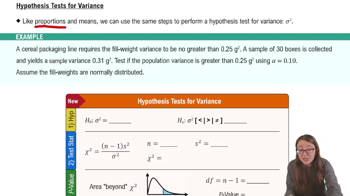
Performing Hypothesis Tests: Variance definitions
You can tap to flip the card.
Population Variance
You can tap to flip the card.
👆
Population Variance
A measure of how data points in an entire group differ from the group mean, often denoted as sigma squared.
Track progress
Control buttons has been changed to "navigation" mode.
1/15
Related flashcards
Related practice
Recommended videos
Performing Hypothesis Tests: Variance quiz
Performing Hypothesis Tests: Variance
15 Terms
9. Hypothesis Testing for One Sample
3 topics
15 problems
Chapter
Brendan
Guided course
04:09
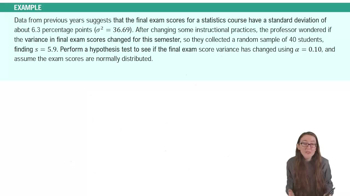
Performing Hypothesis Tests: Variance Example 1
72
views
Guided course
04:05
Performing Hypothesis Tests: Variance
82
views
Terms in this set (15)
Hide definitions
Population Variance
A measure of how data points in an entire group differ from the group mean, often denoted as sigma squared.
Sample Variance
A calculation showing how much sample data values deviate from their mean, used as an estimate for population variance.
Chi-Square Statistic
A value computed to compare observed sample variance to expected population variance in hypothesis testing.
Null Hypothesis
A statement asserting that the population variance equals a specific value, serving as the default assumption.
Alternative Hypothesis
A claim suggesting the population variance differs from the hypothesized value, representing what evidence is sought for.
Alpha Level
A threshold probability, often set before testing, used to decide whether to reject the null hypothesis.
Degrees of Freedom
A value, typically sample size minus one, needed to determine the correct chi-square distribution for the test.
P-Value
A probability indicating how likely the observed test statistic would occur if the null hypothesis were true.
Right Tail Probability
The likelihood that the test statistic is greater than a certain value, used in one-sided variance tests.
Random Sample
A subset of data chosen so every member of the population has an equal chance of selection, ensuring unbiased results.
Normal Distribution
A bell-shaped data pattern required for valid variance hypothesis testing, ensuring accurate probability calculations.
Test Statistic
A calculated value summarizing sample data for comparison against a theoretical distribution in hypothesis testing.
Quality Control
A process in manufacturing or service settings where statistical tests are used to monitor and maintain product consistency.
Statistical Inference
The process of drawing conclusions about a population's characteristics based on sample data analysis.
Sigma Squared
A symbol representing the variance of a population, central to hypothesis tests about variability.
 BackBack
 04:09
04:09