11–86. Applying convergence tests Determine whether the following series converge. Justify your answers.
∑ (from k = 1 to ∞)(1 / √(k + 2) – 1 / √k)
Verified step by step guidance
1
Recognize that the series is given by \( \sum_{k=1}^{\infty} \left( \frac{1}{\sqrt{k+2}} - \frac{1}{\sqrt{k}} \right) \). This is a series whose terms are differences of two expressions involving square roots.
Rewrite the general term to see if the series is telescoping. Notice that each term looks like \( a_k = \frac{1}{\sqrt{k+2}} - \frac{1}{\sqrt{k}} \). Try to express the partial sums \( S_n = \sum_{k=1}^n a_k \) to identify cancellation patterns.
Write out the first few terms of the partial sum explicitly: \( S_n = \left( \frac{1}{\sqrt{3}} - \frac{1}{\sqrt{1}} \right) + \left( \frac{1}{\sqrt{4}} - \frac{1}{\sqrt{2}} \right) + \cdots + \left( \frac{1}{\sqrt{n+2}} - \frac{1}{\sqrt{n}} \right) \). Group the positive and negative terms to observe which terms cancel out.
After cancellation, identify the remaining terms in \( S_n \). Typically, in telescoping series, most intermediate terms cancel, leaving only a few terms from the beginning and end of the sequence.
Analyze the limit of the partial sums \( S_n \) as \( n \to \infty \). If the limit exists and is finite, the series converges; otherwise, it diverges.
Verified video answer for a similar problem:
This video solution was recommended by our tutors as helpful for the problem above
Video duration:
2m
Play a video:
0 Comments
Key Concepts
Here are the essential concepts you must grasp in order to answer the question correctly.
Telescoping Series
A telescoping series is one where many terms cancel out when the series is expanded, simplifying the sum to a difference between a few terms. Recognizing this pattern helps in evaluating the limit of partial sums and determining convergence.
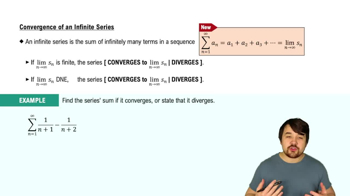
An infinite series converges if the sequence of its partial sums approaches a finite limit. Understanding how to test for convergence, such as by examining partial sums or applying convergence tests, is essential to determine whether the series sums to a finite value.
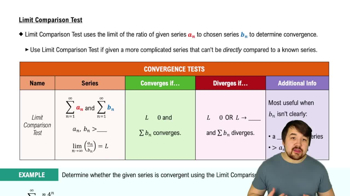
These tests compare a given series to a known benchmark series to determine convergence or divergence. By comparing terms or their limits, one can infer the behavior of the original series, especially when direct evaluation is complex.