9–30. The Ratio and Root Tests Use the Ratio Test or the Root Test to determine whether the following series converge absolutely or diverge. ∑ (from k = 1 to ∞) ((-1)ᵏ⁺¹ × k²ᵏ) / (k! × k!)
Verified step by step guidance
1
Identify the general term of the series as \(a_k = \frac{(-1)^{k+1} \cdot k^{2k}}{(k!) \cdot (k!)}\).
Since the series has alternating signs, to check for absolute convergence, consider the absolute value of the terms: \(|a_k| = \frac{k^{2k}}{(k!)^2}\).
Apply the Ratio Test by computing the limit \(L = \lim_{k \to \infty} \left| \frac{a_{k+1}}{a_k} \right| = \lim_{k \to \infty} \frac{(k+1)^{2(k+1)}}{((k+1)!)^2} \cdot \frac{(k!)^2}{k^{2k}}\).
Simplify the expression inside the limit by expressing factorials and powers explicitly, for example, \((k+1)! = (k+1) \cdot k!\), and rewrite powers to compare terms.
Evaluate the limit \(L\) and use the Ratio Test criteria: if \(L < 1\), the series converges absolutely; if \(L > 1\), it diverges; if \(L = 1\), the test is inconclusive.
Verified video answer for a similar problem:
This video solution was recommended by our tutors as helpful for the problem above
Video duration:
4m
Play a video:
0 Comments
Key Concepts
Here are the essential concepts you must grasp in order to answer the question correctly.
Ratio Test
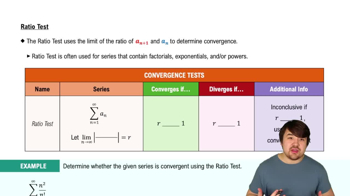
The Ratio Test determines the convergence of a series by examining the limit of the absolute value of the ratio of consecutive terms. If this limit is less than 1, the series converges absolutely; if greater than 1, it diverges; if equal to 1, the test is inconclusive.
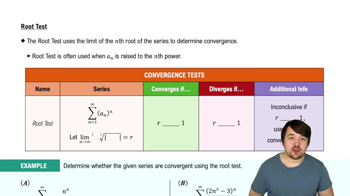
The Root Test analyzes the nth root of the absolute value of the terms in a series. If the limit of this nth root as n approaches infinity is less than 1, the series converges absolutely; if greater than 1, it diverges; if equal to 1, the test is inconclusive.
A series converges absolutely if the series of the absolute values of its terms converges. Absolute convergence implies convergence regardless of the sign of terms, which is important when dealing with alternating series like the given one.