27–37. Evaluating series Evaluate the following infinite series or state that the series diverges. ∑ (from k = 1 to ∞)ln((2k + 1) / (2k − 1))
Verified step by step guidance
1
Start by writing out the general term of the series: \( a_k = \ln\left(\frac{2k + 1}{2k - 1}\right) \).
Use the logarithm property \( \ln\left(\frac{A}{B}\right) = \ln(A) - \ln(B) \) to rewrite the term as \( a_k = \ln(2k + 1) - \ln(2k - 1) \).
Express the partial sum \( S_n = \sum_{k=1}^n a_k \) by substituting the expanded terms: \( S_n = \sum_{k=1}^n \left( \ln(2k + 1) - \ln(2k - 1) \right) \).
Rewrite the partial sum as \( S_n = \left( \ln 3 - \ln 1 \right) + \left( \ln 5 - \ln 3 \right) + \left( \ln 7 - \ln 5 \right) + \cdots + \left( \ln(2n + 1) - \ln(2n - 1) \right) \) and observe the telescoping pattern where most terms cancel out.
Simplify the telescoping sum to \( S_n = \ln(2n + 1) - \ln 1 \), then analyze the limit \( \lim_{n \to \infty} S_n = \lim_{n \to \infty} \ln(2n + 1) \) to determine whether the series converges or diverges.
Verified video answer for a similar problem:
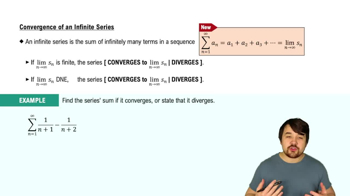
This video solution was recommended by our tutors as helpful for the problem above
Video duration:
2m
Play a video:
0 Comments
Key Concepts
Here are the essential concepts you must grasp in order to answer the question correctly.
Infinite Series and Convergence
An infinite series is the sum of infinitely many terms. To evaluate such a series, it is crucial to determine whether it converges (approaches a finite limit) or diverges (grows without bound or oscillates). Convergence tests help decide if the sum exists.
Logarithmic properties, such as ln(a/b) = ln(a) - ln(b), allow simplification of terms in the series. Applying these properties can transform the series into a telescoping form or other manageable expressions, facilitating evaluation.
A telescoping series is one where many terms cancel out when the series is expanded, leaving only a few terms to sum. Recognizing telescoping behavior is key to simplifying and finding the sum of certain infinite series involving differences of logarithms.