Maximum height of a vertically moving body The height of a body moving vertically is given by s = −12gt² + υ₀t + s₀, g > 0, with s in meters and t in seconds. Find the body’s maximum height.
Verified step by step guidance
1
Identify the given equation for the height of the body: \( s(t) = -12gt^2 + v_0t + s_0 \), where \( g \) is the acceleration due to gravity, \( v_0 \) is the initial velocity, and \( s_0 \) is the initial height.
To find the maximum height, we need to determine the time \( t \) at which the velocity is zero. The velocity \( v(t) \) is the derivative of the height function \( s(t) \) with respect to time \( t \).
Set the velocity \( v(t) \) to zero to find the critical point: \( -24gt + v_0 = 0 \). Solve for \( t \) to find \( t = \frac{v_0}{24g} \).
Substitute \( t = \frac{v_0}{24g} \) back into the original height equation \( s(t) \) to find the maximum height: \( s_{max} = -12g\left(\frac{v_0}{24g}\right)^2 + v_0\left(\frac{v_0}{24g}\right) + s_0 \). Simplify this expression to find the maximum height.
Verified video answer for a similar problem:
This video solution was recommended by our tutors as helpful for the problem above
Video duration:
4m
Play a video:
0 Comments
Key Concepts
Here are the essential concepts you must grasp in order to answer the question correctly.
Quadratic Functions
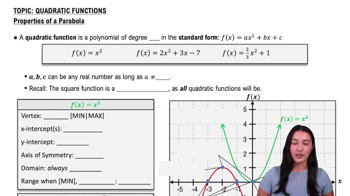
A quadratic function is a polynomial of degree two, typically in the form of ax² + bx + c. The graph of a quadratic function is a parabola, which can open upwards or downwards. In the context of the problem, the height function s = −12gt² + υ₀t + s₀ is a quadratic function of time t, where the coefficient of t² determines the direction of the parabola.
The vertex of a parabola is the point where it reaches its maximum or minimum value. For a quadratic function in the form ax² + bx + c, the vertex can be found using the formula t = -b/(2a). In this problem, the vertex represents the time at which the body reaches its maximum height, as the parabola opens downwards due to the negative coefficient of t².
The derivative of a function gives the rate of change and can be used to find critical points where the function's slope is zero. These points are potential maxima or minima. For the height function, taking the derivative with respect to time and setting it to zero helps find the time at which the maximum height occurs, confirming the vertex calculation.