Answer the following questions about the functions whose derivatives are given in Exercises 1–14:
a. What are the critical points of f?
f′(x) = (x − 1)²(x + 2)
Verified step by step guidance
1
To find the critical points of the function f, we need to determine where its derivative f'(x) is equal to zero or undefined. In this case, f'(x) = (x - 1)²(x + 2).
Set the derivative equal to zero: (x - 1)²(x + 2) = 0. This equation will help us find the values of x where the derivative is zero, indicating potential critical points.
Solve the equation (x - 1)²(x + 2) = 0 by setting each factor equal to zero: (x - 1)² = 0 and (x + 2) = 0.
For (x - 1)² = 0, solve for x to get x = 1. This is a critical point because the derivative is zero at this value.
For (x + 2) = 0, solve for x to get x = -2. This is another critical point because the derivative is zero at this value.
Verified video answer for a similar problem:
This video solution was recommended by our tutors as helpful for the problem above
Video duration:
1m
Play a video:
0 Comments
Key Concepts
Here are the essential concepts you must grasp in order to answer the question correctly.
Critical Points
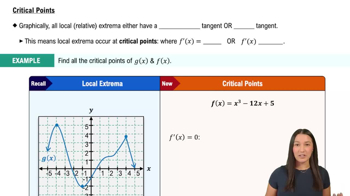
Critical points of a function occur where its derivative is zero or undefined. These points are significant because they can indicate local maxima, minima, or points of inflection. To find critical points, set the derivative equal to zero and solve for the variable, or identify where the derivative does not exist.
Factoring polynomials involves expressing a polynomial as a product of its factors. This is crucial for solving equations where the polynomial is set to zero, as it allows us to find the roots or solutions. In the given derivative, f′(x) = (x − 1)²(x + 2), factoring helps identify the values of x that make the derivative zero.
Analyzing the derivative of a function provides insights into the function's behavior, such as increasing or decreasing intervals and concavity. The sign and value of the derivative indicate the slope of the tangent line at any point on the function. For f′(x) = (x − 1)²(x + 2), examining the derivative helps determine where the function changes direction or has potential extrema.