In Exercises 53 and 54, show that the function has neither an absolute minimum nor an absolute maximum on its natural domain.
y = x¹¹ + x³ + x − 5
Verified step by step guidance
1
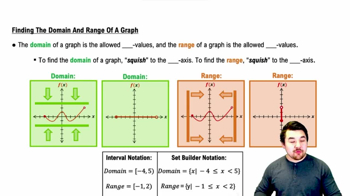
First, identify the natural domain of the function y = x¹¹ + x³ + x − 5. Since this is a polynomial function, its domain is all real numbers, ℝ.
Next, consider the behavior of the function as x approaches positive and negative infinity. For large values of x, the term x¹¹ will dominate the behavior of the function because it has the highest degree.
Analyze the leading term x¹¹: As x approaches positive infinity, x¹¹ also approaches positive infinity, and as x approaches negative infinity, x¹¹ approaches negative infinity. This indicates that the function does not have a bound in either direction.
To further investigate, find the derivative of the function, y' = 11x¹⁰ + 3x² + 1, to determine critical points where the function might have local extrema. Set y' = 0 and solve for x to find these points.
Evaluate the second derivative, y'' = 110x⁹ + 6x, to determine the concavity at the critical points. This will help confirm whether these points are local minima or maxima. However, since the function is unbounded, these local extrema cannot be absolute extrema.
Verified video answer for a similar problem:
This video solution was recommended by our tutors as helpful for the problem above
Video duration:
2m
Play a video:
0 Comments
Key Concepts
Here are the essential concepts you must grasp in order to answer the question correctly.
Natural Domain
The natural domain of a function is the set of all real numbers for which the function is defined. For polynomial functions like y = x¹¹ + x³ + x − 5, the natural domain is all real numbers, as polynomials are defined for every real number without restrictions such as division by zero or square roots of negative numbers.
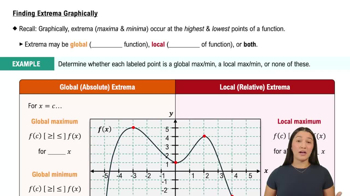
Absolute extrema refer to the highest or lowest points (maximum or minimum) of a function over its entire domain. A function has an absolute maximum at a point if its value there is greater than or equal to its value at any other point in the domain, and an absolute minimum if its value is less than or equal to any other point. For polynomials of odd degree, like y = x¹¹ + x³ + x − 5, the function tends to infinity as x approaches positive or negative infinity, often resulting in no absolute extrema.
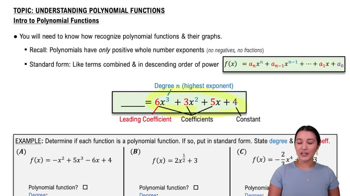
The behavior of polynomial functions, especially those of odd degree, is crucial in determining the presence of absolute extrema. Odd-degree polynomials, such as y = x¹¹ + x³ + x − 5, have end behaviors where one end goes to positive infinity and the other to negative infinity. This characteristic implies that such functions do not have absolute maxima or minima, as they do not level off at any finite value across their domain.