23–68. Indefinite integrals Determine the following indefinite integrals. Check your work by differentiation.
∫ ((e²ʷ - 5eʷ + 4)/(eʷ - 1))dw
Verified step by step guidance
1
Step 1: Begin by analyzing the integrand ∫ ((e²ʷ - 5eʷ + 4)/(eʷ - 1)) dw. Notice that the numerator (e²ʷ - 5eʷ + 4) and denominator (eʷ - 1) suggest the possibility of polynomial division to simplify the fraction.
Step 2: Perform polynomial division. Divide the numerator (e²ʷ - 5eʷ + 4) by the denominator (eʷ - 1). This will yield a quotient and possibly a remainder. Write the integrand as the sum of the quotient and the remainder divided by the denominator.
Step 3: After simplifying, the integrand will be expressed as a sum of simpler terms. Break the integral into separate parts based on this decomposition. For example, ∫ (quotient) dw + ∫ (remainder/(eʷ - 1)) dw.
Step 4: Evaluate each term separately. For the quotient term, integrate directly. For the remainder term, consider substitution or other techniques if necessary. For example, if the remainder term involves (eʷ - 1), you might use substitution u = eʷ - 1.
Step 5: Combine the results of the individual integrals to write the final expression for the indefinite integral. Finally, check your work by differentiating the result to ensure it matches the original integrand.
Verified video answer for a similar problem:
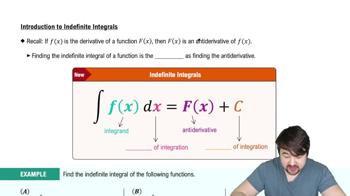
This video solution was recommended by our tutors as helpful for the problem above
Video duration:
1m
Play a video:
0 Comments
Key Concepts
Here are the essential concepts you must grasp in order to answer the question correctly.
Indefinite Integrals
Indefinite integrals represent a family of functions whose derivative is the integrand. They are expressed without limits and include a constant of integration, typically denoted as 'C'. The process of finding an indefinite integral is often referred to as antiderivation, where one seeks a function whose derivative matches the given function.
To solve integrals, various techniques can be employed, such as substitution, integration by parts, or partial fraction decomposition. In this case, recognizing the structure of the integrand can help simplify the integral. For rational functions, breaking them down into simpler fractions can make integration more manageable.
After finding an indefinite integral, it is essential to verify the result by differentiating the antiderivative. This process ensures that the derivative of the obtained function returns to the original integrand. This step is crucial for confirming the correctness of the integration process and solidifying understanding of the relationship between differentiation and integration.