7–64. Integration review Evaluate the following integrals. 7. ∫ dx / (3 - 5x)^4
Verified step by step guidance
1
Recognize that the integral ∫ dx / (3 - 5x)^4 involves a rational function with a power of a linear term in the denominator. This suggests using a substitution to simplify the integral.
Let u = 3 - 5x. Then, compute the derivative of u with respect to x: du/dx = -5, or equivalently, dx = -du/5.
Substitute u and dx into the integral. The integral becomes ∫ (-1/5) du / u^4, where the factor -1/5 comes from the substitution for dx.
Simplify the integral to ∫ -1/5 * u^(-4) du. Rewrite the integrand as -1/5 * u^(-4) to prepare for applying the power rule of integration.
Apply the power rule for integration: ∫ u^n du = u^(n+1) / (n+1), for n ≠ -1. Here, n = -4, so the integral becomes (-1/5) * (u^(-4+1) / (-4+1)). Simplify the expression and substitute back u = 3 - 5x to return to the original variable.
Verified video answer for a similar problem:
This video solution was recommended by our tutors as helpful for the problem above
Video duration:
4m
Play a video:
0 Comments
Key Concepts
Here are the essential concepts you must grasp in order to answer the question correctly.
Integration Techniques
Integration techniques are methods used to find the integral of a function. Common techniques include substitution, integration by parts, and partial fractions. In this case, substitution is particularly useful for simplifying the integral of a rational function, allowing for easier evaluation.
The substitution method involves replacing a variable in the integral with another variable to simplify the expression. For the integral ∫ dx / (3 - 5x)^4, we can let u = 3 - 5x, which transforms the integral into a more manageable form. This method is essential for integrals involving composite functions.
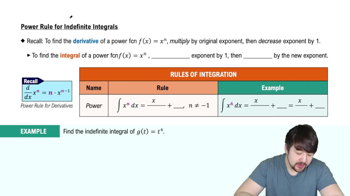
The power rule for integration states that ∫ x^n dx = (x^(n+1))/(n+1) + C, where n ≠ -1. This rule is applicable when integrating functions of the form u^n, where u is a function of x. In the given integral, after substitution, applying the power rule will help in finding the antiderivative of the transformed function.