Evaluating integrals Evaluate the following integrals. ∫ d𝓍/[(tan⁻¹ 𝓍) (1 + 𝓍²)]
Verified step by step guidance
1
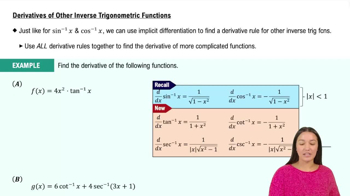
Step 1: Recognize the integral ∫ d𝓍/[(tan⁻¹ 𝓍) (1 + 𝓍²)] and identify the components. The denominator contains (tan⁻¹ 𝓍), which is the inverse tangent function, and (1 + 𝓍²), which is related to the derivative of tan⁻¹ 𝓍.
Step 2: Recall the derivative of tan⁻¹ 𝓍, which is d/d𝓍(tan⁻¹ 𝓍) = 1/(1 + 𝓍²). This suggests that the integral might involve a substitution to simplify the expression.
Step 3: Let u = tan⁻¹ 𝓍. Then, differentiate u with respect to 𝓍: du/d𝓍 = 1/(1 + 𝓍²), or equivalently, du = d𝓍/(1 + 𝓍²). Substitute this into the integral.
Step 4: After substitution, the integral becomes ∫ du/u, which is a standard form. The integral of 1/u with respect to u is ln|u| + C, where C is the constant of integration.
Step 5: Replace u back with tan⁻¹ 𝓍 to return to the original variable. The final expression is ln|tan⁻¹ 𝓍| + C.
Verified video answer for a similar problem:
This video solution was recommended by our tutors as helpful for the problem above
Video duration:
3m
Play a video:
0 Comments
Key Concepts
Here are the essential concepts you must grasp in order to answer the question correctly.
Integration
Integration is a fundamental concept in calculus that involves finding the integral of a function, which represents the area under the curve of that function on a given interval. It can be understood as the reverse process of differentiation. There are various techniques for integration, including substitution, integration by parts, and partial fractions, which are essential for evaluating complex integrals.
Inverse trigonometric functions, such as arctan (tan⁻¹), are functions that return the angle whose tangent is a given number. These functions are crucial in calculus, especially in integration, as they often appear in integrals involving rational functions. Understanding their properties and derivatives is essential for manipulating and solving integrals that include these functions.
Derivatives of Other Inverse Trigonometric Functions
Differentiation of Composite Functions
The differentiation of composite functions, often referred to as the chain rule, is a key concept in calculus that allows us to differentiate functions that are composed of other functions. This is particularly important when dealing with integrals that involve products of functions, such as the one in the given question. Mastery of the chain rule aids in simplifying and solving integrals effectively.