Locating extrema Consider the graph of a function ƒ on the interval [-3, 3]. <IMAGE> e. On what intervals (approximately) is f concave up?
Verified step by step guidance
1
To determine where the function f is concave up, we need to analyze the second derivative, f''(x). A function is concave up on intervals where its second derivative is positive.
First, find the first derivative f'(x) of the function f. This will help us understand the slope of the tangent line at any point on the graph.
Next, find the second derivative f''(x) by differentiating f'(x). This will give us information about the curvature of the graph.
Examine the sign of f''(x) over the interval [-3, 3]. Identify the subintervals where f''(x) > 0, as these are the intervals where the function is concave up.
If the graph of f is provided, visually inspect the graph to confirm the intervals where the curvature is upwards, which corresponds to f''(x) being positive.
Verified video answer for a similar problem:
This video solution was recommended by our tutors as helpful for the problem above
Video duration:
2m
Play a video:
0 Comments
Key Concepts
Here are the essential concepts you must grasp in order to answer the question correctly.
Concavity
Concavity refers to the direction in which a function curves. A function is concave up on an interval if its graph opens upwards, resembling a cup. This occurs when the second derivative of the function is positive, indicating that the slope of the tangent line is increasing.
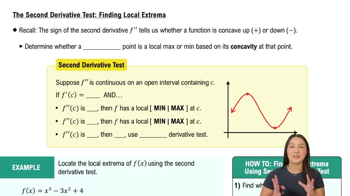
The second derivative test is a method used to determine the concavity of a function. If the second derivative, denoted as f''(x), is greater than zero on an interval, the function is concave up on that interval. Conversely, if f''(x) is less than zero, the function is concave down.
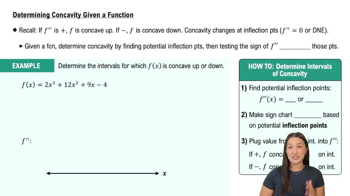
Intervals of concavity are specific ranges on the x-axis where a function maintains a consistent concavity. To find these intervals, one typically analyzes the sign of the second derivative across the domain of the function, identifying where it remains positive or negative to determine where the function is concave up or down.

 2:03 minutes
 Verified step by step guidance
 05:59
05:59