113. If b, c, and d are constants, for what value of b will the curve y = x^3 + bx^2 + cx + d have a point of inflection at x = 1? Give reasons for your answer.
Verified step by step guidance
1
To find the point of inflection, we need to determine where the second derivative of the function changes sign. Start by finding the first derivative of the function y = x^3 + bx^2 + cx + d. The first derivative is y' = 3x^2 + 2bx + c.
Next, find the second derivative of the function. Differentiate the first derivative to get y'' = 6x + 2b.
A point of inflection occurs where the second derivative is zero or undefined, and changes sign. Set the second derivative equal to zero: 6x + 2b = 0.
Solve the equation 6x + 2b = 0 for x = 1, since the point of inflection is given to be at x = 1. Substitute x = 1 into the equation: 6(1) + 2b = 0.
Solve the equation 6 + 2b = 0 for b to find the value of b that ensures the curve has a point of inflection at x = 1.
Verified video answer for a similar problem:

This video solution was recommended by our tutors as helpful for the problem above
Video duration:
3m
Play a video:
0 Comments
Key Concepts
Here are the essential concepts you must grasp in order to answer the question correctly.
Point of Inflection
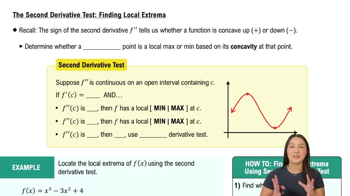
A point of inflection on a curve is where the concavity changes from concave up to concave down, or vice versa. This occurs where the second derivative of the function changes sign. To find such points, we set the second derivative equal to zero and solve for the variable.
The second derivative of a function, denoted as f''(x), provides information about the concavity of the function. It is the derivative of the first derivative, f'(x). If f''(x) > 0, the function is concave up, and if f''(x) < 0, it is concave down. A change in sign of f''(x) indicates a potential point of inflection.
To find the derivatives of a polynomial function, apply the power rule: for a term ax^n, the derivative is n*ax^(n-1). For the function y = x^3 + bx^2 + cx + d, the first derivative is 3x^2 + 2bx + c, and the second derivative is 6x + 2b. These derivatives are used to analyze the behavior of the curve, such as finding points of inflection.