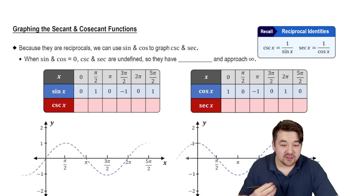
a. Graph y = cos x and y = sec x together for −3π/2 ≤ x ≤ 3π/2. Comment on the behavior of sec x in relation to the signs and values of cos x.
Verified step by step guidance
1
Start by understanding the relationship between the functions y = cos(x) and y = sec(x). Recall that sec(x) is the reciprocal of cos(x), meaning sec(x) = 1/cos(x). This implies that sec(x) is undefined wherever cos(x) is zero.
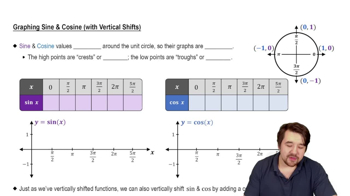
Graph y = cos(x) over the interval −3π/2 ≤ x ≤ 3π/2. The cosine function is periodic with a period of 2π, and it oscillates between -1 and 1. Identify the key points where cos(x) equals 0, which are at x = -π/2, x = π/2, and x = 3π/2 within the given interval.
Graph y = sec(x) over the same interval. Since sec(x) = 1/cos(x), wherever cos(x) is zero, sec(x) will have vertical asymptotes. These occur at x = -π/2, x = π/2, and x = 3π/2. Between these points, sec(x) will take on positive values when cos(x) is positive and negative values when cos(x) is negative.
Observe the behavior of sec(x) in relation to cos(x). When cos(x) is positive, sec(x) will also be positive and greater than or equal to 1. When cos(x) is negative, sec(x) will be negative and less than or equal to -1. The magnitude of sec(x) increases as the value of cos(x) approaches zero from either side.
Comment on the graph: Notice that sec(x) has vertical asymptotes at the points where cos(x) crosses zero. Between these asymptotes, sec(x) mirrors the sign of cos(x) but with larger magnitude, especially as cos(x) approaches zero. This behavior highlights the reciprocal nature of sec(x) relative to cos(x).
Verified video answer for a similar problem:
This video solution was recommended by our tutors as helpful for the problem above
Video duration:
11m
Play a video:
0 Comments
Key Concepts
Here are the essential concepts you must grasp in order to answer the question correctly.
Cosine Function
The cosine function, denoted as cos(x), is a periodic function that represents the x-coordinate of a point on the unit circle corresponding to an angle x. It oscillates between -1 and 1, with a period of 2π. Understanding its graph is crucial for analyzing the behavior of related functions, such as secant.
The secant function, denoted as sec(x), is the reciprocal of the cosine function, defined as sec(x) = 1/cos(x). It is undefined wherever cos(x) equals zero, leading to vertical asymptotes in its graph. The behavior of sec(x) is directly influenced by the values of cos(x), particularly its signs.
Graphing trigonometric functions involves plotting their values over a specified interval, which helps visualize their periodic nature and relationships. When graphing y = cos(x) and y = sec(x) together, one can observe how sec(x) behaves in relation to cos(x), particularly noting where sec(x) approaches infinity as cos(x) approaches zero.

 11:25 minutes
 Verified step by step guidance
 5:53
5:53