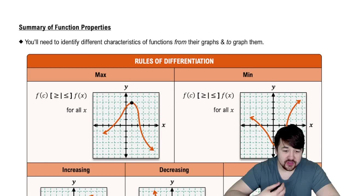
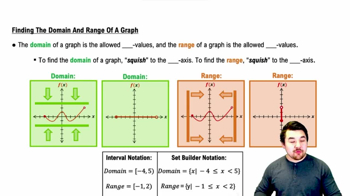
Graph y = sin x and y = ⌊sin x⌋ together. What are the domain and range of ⌊sin x⌋?
Verified step by step guidance
1
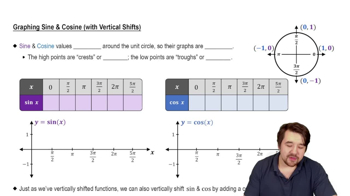
Step 1: Understand the function y = sin x. The sine function is periodic with a period of 2π, and it oscillates between -1 and 1. Its domain is all real numbers, and its range is [-1, 1].
Step 2: Understand the function y = ⌊sin x⌋. The floor function, denoted by ⌊x⌋, returns the greatest integer less than or equal to x. For y = ⌊sin x⌋, this means it will take the value of the greatest integer less than or equal to the sine of x.
Step 3: Determine the domain of y = ⌊sin x⌋. Since the sine function is defined for all real numbers, the domain of ⌊sin x⌋ is also all real numbers.
Step 4: Determine the range of y = ⌊sin x⌋. Since sin x oscillates between -1 and 1, ⌊sin x⌋ will take integer values within this range. Specifically, ⌊sin x⌋ can be -1, 0, or 1 depending on the value of sin x.
Step 5: Graph y = sin x and y = ⌊sin x⌋ together. On the graph, y = sin x will be a smooth wave oscillating between -1 and 1, while y = ⌊sin x⌋ will be a step function that jumps between -1, 0, and 1 at the points where sin x crosses integer values.
Verified video answer for a similar problem:
This video solution was recommended by our tutors as helpful for the problem above
Video duration:
12m
Play a video:
0 Comments
Key Concepts
Here are the essential concepts you must grasp in order to answer the question correctly.
Sine Function
The sine function, denoted as y = sin x, is a periodic function that oscillates between -1 and 1. It is defined for all real numbers and is commonly used in trigonometry. The graph of y = sin x exhibits a wave-like pattern, repeating every 2π radians, which is essential for understanding its behavior and properties.
The floor function, denoted as ⌊x⌋, maps a real number x to the largest integer less than or equal to x. When applied to the sine function, ⌊sin x⌋ takes the output of sin x and rounds it down to the nearest integer. This transformation alters the continuous wave of sin x into a step function, which has distinct characteristics in terms of its domain and range.
The domain of a function refers to the set of all possible input values (x-values) for which the function is defined, while the range is the set of all possible output values (y-values). For the floor function applied to sin x, the domain remains all real numbers, but the range becomes limited to the integers -1 and 0, reflecting the integer outputs of the floor function when applied to the sine values.

 12:40 minutes
 Verified step by step guidance
 5:53
5:53