
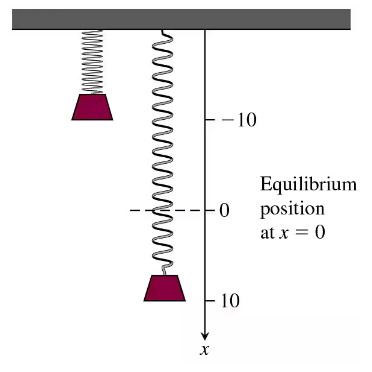
A weight is attached to a spring and reaches its equilibrium position (x = 0). It is then set in motion resulting in a displacement of x = 10 cos t, where x is measured in centimeters and t is measured in seconds. See the accompanying figure. Find the spring’s displacement when t = 0, t = π/3, and t = 3π/4.
Verified step by step guidance
1
Identify the displacement function given in the problem: x(t) = 10 cos(t). This function describes the displacement of the spring from its equilibrium position over time.
To find the displacement at a specific time, substitute the given time value into the displacement function. Start with t = 0: x(0) = 10 cos(0).
Evaluate the cosine function at t = 0. Recall that cos(0) = 1, so x(0) = 10 * 1.
Next, substitute t = π/3 into the displacement function: x(π/3) = 10 cos(π/3).
Evaluate the cosine function at t = π/3. Recall that cos(π/3) = 1/2, so x(π/3) = 10 * 1/2.
Verified video answer for a similar problem:
This video solution was recommended by our tutors as helpful for the problem above
Video duration:
1m
Play a video:
0 Comments
Key Concepts
Here are the essential concepts you must grasp in order to answer the question correctly.
Equilibrium Position
The equilibrium position of a spring is the point where the net force acting on the spring is zero. In this context, it is represented by x = 0, where the spring is neither compressed nor stretched. When a weight is attached and set in motion, it oscillates around this equilibrium point, demonstrating simple harmonic motion.
Simple Harmonic Motion is a type of periodic motion where an object moves back and forth around an equilibrium position. The displacement of the object can be described by a cosine or sine function, such as x = 10 cos(t), indicating that the motion is sinusoidal and the object oscillates with a specific amplitude and period.
Trigonometric functions, such as cosine and sine, are fundamental in describing oscillatory motion. In this case, the displacement of the spring is given by x = 10 cos(t), where the cosine function determines the position of the spring at any time t. Understanding these functions is crucial for calculating the displacement at specific time intervals.