On a circle of radius 10 m, how long is an arc that subtends a central angle of (a) 4π/5 radians? (b) 110°?
Verified step by step guidance
1
Step 1: Understand the relationship between arc length, radius, and central angle. The formula for arc length (L) is given by L = rθ, where r is the radius and θ is the central angle in radians.
Step 2: For part (a), identify the given values: radius r = 10 m and central angle θ = 4π/5 radians. Use the formula L = rθ to find the arc length.
Step 3: Substitute the values into the formula for part (a): L = 10 * (4π/5). Simplify the expression to find the arc length in meters.
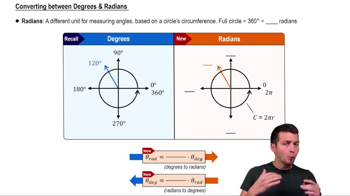
Step 4: For part (b), convert the central angle from degrees to radians. Recall that 1 degree = π/180 radians. Therefore, 110° = 110 * (π/180) radians.
Step 5: Use the formula L = rθ again for part (b) with the converted angle in radians: L = 10 * (110 * (π/180)). Simplify the expression to find the arc length in meters.
Verified video answer for a similar problem:
This video solution was recommended by our tutors as helpful for the problem above
Video duration:
1m
Play a video:
0 Comments
Key Concepts
Here are the essential concepts you must grasp in order to answer the question correctly.
Arc Length Formula
The arc length of a circle can be calculated using the formula L = rθ, where L is the arc length, r is the radius, and θ is the central angle in radians. This formula is essential for determining the length of an arc based on the angle subtended at the center of the circle.
Radians and degrees are two units for measuring angles. To convert degrees to radians, use the formula radians = degrees × (π/180). Understanding this conversion is crucial when working with angles in different units, especially in problems involving circular motion.
A circle is defined by its radius, which is the distance from the center to any point on the circle. The relationship between the radius, circumference, and arc length is fundamental in geometry and calculus, as it helps in understanding how angles and distances relate in circular motion.