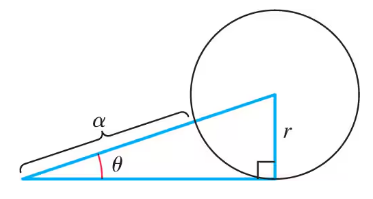
Refer to the given figure. Write the radius r of the circle in terms of α and θ.
Verified step by step guidance
1
Step 1: Begin by understanding the relationship between the angle α, angle θ, and the radius r of the circle. Typically, these angles are part of a geometric configuration involving circles, such as sectors or segments.
Step 2: Consider the geometric properties of the circle. If α and θ are angles subtended by arcs or sectors, they might relate to the radius through trigonometric identities or geometric formulas.
Step 3: Use trigonometric identities or geometric relationships to express r in terms of α and θ. For example, if α and θ are angles in a right triangle formed by the radius, you might use sine, cosine, or tangent functions.
Step 4: If the figure involves a sector of the circle, recall that the arc length or area of the sector can be used to relate the radius to the angles. The formula for arc length is L = rθ, where θ is in radians.
Step 5: Combine the relationships and formulas derived from the figure to express the radius r solely in terms of α and θ. Ensure that any assumptions made about the figure are consistent with the given angles and their geometric context.
Verified video answer for a similar problem:
This video solution was recommended by our tutors as helpful for the problem above
Video duration:
3m
Play a video:
0 Comments
Key Concepts
Here are the essential concepts you must grasp in order to answer the question correctly.
Circle Geometry
Understanding the properties of circles is essential for solving problems involving their dimensions. The radius is a key feature, defined as the distance from the center of the circle to any point on its circumference. In terms of angles, the relationship between the radius and angles like α and θ can often be explored using trigonometric functions.
Trigonometric functions such as sine, cosine, and tangent relate the angles of a triangle to the ratios of its sides. In the context of a circle, these functions can help express the radius in terms of angles. For example, if α and θ represent angles in a right triangle inscribed in the circle, the radius can be derived using these functions.
Coordinate systems, particularly polar coordinates, are often used to describe points in relation to a circle. In polar coordinates, a point is defined by its distance from the origin (the radius) and the angle from the positive x-axis. Understanding how to convert between polar and Cartesian coordinates is crucial for expressing the radius in terms of angles like α and θ.