62–65. {Use of Tech} Graphing f and f' c. Verify that the zeros of f' correspond to points at which f has a horizontal tangent line. f(x)=(sec^−1 x)/x on [1,∞)
Verified step by step guidance
1
Step 1: Understand the function f(x) = \(\frac{\sec^{-1}\)(x)}{x} and its domain [1, \(\infty\)). The function involves the inverse secant function, which is defined for x \(\geq\) 1.
Step 2: Find the derivative f'(x) using the quotient rule. The quotient rule states that if you have a function h(x) = \(\frac{u(x)}{v(x)}\), then h'(x) = \(\frac{u'(x)v(x) - u(x)v'(x)}{(v(x))^2}\). Here, u(x) = \(\sec\)^{-1}(x) and v(x) = x.
Step 3: Calculate the derivatives u'(x) and v'(x). For u(x) = \(\sec\)^{-1}(x), use the derivative formula \(\frac{d}{dx}\)[\(\sec\)^{-1}(x)] = \(\frac{1}{|x|\sqrt{x^2 - 1}\)}. For v(x) = x, the derivative v'(x) = 1.
Step 4: Substitute u'(x), u(x), v'(x), and v(x) into the quotient rule formula to find f'(x). Simplify the expression to get the derivative in a manageable form.
Step 5: Set f'(x) = 0 to find the zeros of the derivative. These zeros correspond to the x-values where the original function f(x) has horizontal tangent lines. Verify these points by checking the graph of f(x) and f'(x) using technology.
Verified video answer for a similar problem:
This video solution was recommended by our tutors as helpful for the problem above
Video duration:
8m
Play a video:
0 Comments
Key Concepts
Here are the essential concepts you must grasp in order to answer the question correctly.
Derivative and Critical Points
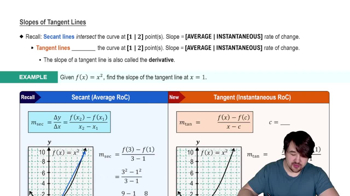
The derivative of a function, denoted as f'(x), represents the rate of change of the function f(x) at any point x. Critical points occur where the derivative is zero or undefined, indicating potential locations for horizontal tangent lines. Understanding how to find and interpret these points is essential for analyzing the behavior of the function.
A horizontal tangent line occurs at points where the derivative of a function equals zero, meaning the slope of the tangent line is flat. This indicates that the function is neither increasing nor decreasing at that point, which is crucial for identifying local maxima, minima, or points of inflection. Verifying these points involves checking where f'(x) = 0.
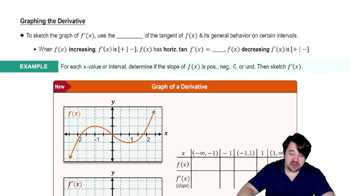
Graphing a function f(x) alongside its derivative f'(x) provides visual insight into the function's behavior. The zeros of f' correspond to the x-values where f has horizontal tangents, allowing for a clear understanding of how the function behaves at those points. This graphical representation aids in confirming the relationship between a function and its derivative.

 8:05 minutes
 Verified step by step guidance
 04:50
04:50