Explain why or why not Determine whether the following statements are true and give an explanation or counterexample. b. d/dx(tan^−1 x) =sec² x
Verified step by step guidance
1
To determine whether the statement \( \frac{d}{dx}(\tan^{-1} x) = \sec^2 x \) is true, we need to find the derivative of \( \tan^{-1} x \).
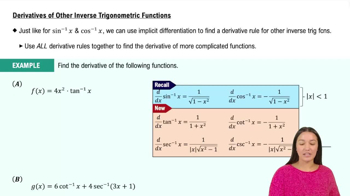
Recall that \( \tan^{-1} x \) is the inverse function of \( \tan x \). The derivative of \( \tan^{-1} x \) is given by the formula \( \frac{d}{dx}(\tan^{-1} x) = \frac{1}{1 + x^2} \).
Compare the derivative \( \frac{1}{1 + x^2} \) with \( \sec^2 x \). Note that \( \sec^2 x = 1 + \tan^2 x \), which is different from \( \frac{1}{1 + x^2} \).
Since \( \frac{1}{1 + x^2} \) is not equal to \( \sec^2 x \), the statement \( \frac{d}{dx}(\tan^{-1} x) = \sec^2 x \) is false.
Therefore, the correct derivative of \( \tan^{-1} x \) is \( \frac{1}{1 + x^2} \), not \( \sec^2 x \). This serves as a counterexample to the given statement.
Verified video answer for a similar problem:
This video solution was recommended by our tutors as helpful for the problem above
Video duration:
3m
Play a video:
0 Comments
Key Concepts
Here are the essential concepts you must grasp in order to answer the question correctly.
Derivative of Inverse Functions
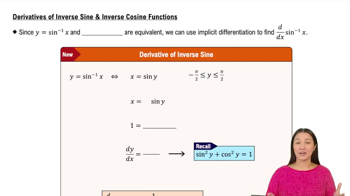
The derivative of an inverse function can be found using the formula (d/dx)(f^−1(x)) = 1/(f'(f^−1(x))). For the function f(x) = tan(x), its inverse is f^−1(x) = tan^−1(x). Understanding this relationship is crucial for differentiating inverse trigonometric functions like tan^−1(x).
Knowing the derivatives of basic trigonometric functions is essential. For example, the derivative of tan(x) is sec²(x). This knowledge helps in finding the derivative of its inverse, tan^−1(x), and is fundamental in verifying the correctness of derivative statements.
Derivatives of Other Inverse Trigonometric Functions
Chain Rule
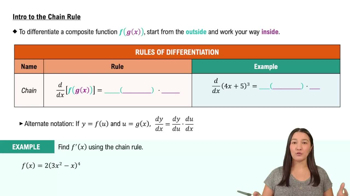
The chain rule is a fundamental principle in calculus used to differentiate composite functions. It states that if a function y = f(g(x)), then dy/dx = f'(g(x)) * g'(x). This rule is particularly useful when dealing with functions like tan^−1(x) that can be expressed in terms of other functions, aiding in the differentiation process.

 3:13 minutes
 Verified step by step guidance
 07:26
07:26