Evaluate the derivative of the following functions. f(x) = sin(tan-1 (ln x))
Verified step by step guidance
1
First, identify the outermost function in the composition. Here, the function is f(x) = sin(u), where u = tan^(-1)(ln(x)).
Apply the chain rule for derivatives, which states that the derivative of a composite function f(g(x)) is f'(g(x)) * g'(x). In this case, differentiate sin(u) with respect to u, which gives cos(u).
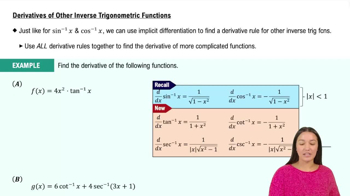
Next, differentiate the inner function u = tan^(-1)(ln(x)) with respect to x. Start by differentiating tan^(-1)(v) with respect to v, which is 1/(1+v^2). Here, v = ln(x).
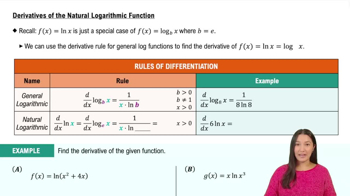
Now, differentiate ln(x) with respect to x, which is 1/x. Combine this with the previous step to find the derivative of u with respect to x: (1/(1+(ln(x))^2)) * (1/x).
Finally, combine the results using the chain rule: f'(x) = cos(tan^(-1)(ln(x))) * (1/(1+(ln(x))^2)) * (1/x). This is the derivative of the given function.
Verified video answer for a similar problem:
This video solution was recommended by our tutors as helpful for the problem above
Video duration:
8m
Play a video:
0 Comments
Key Concepts
Here are the essential concepts you must grasp in order to answer the question correctly.
Chain Rule
The Chain Rule is a fundamental principle in calculus used to differentiate composite functions. It states that if a function y is composed of two functions u and v, then the derivative of y with respect to x can be found by multiplying the derivative of y with respect to u by the derivative of u with respect to x. This rule is essential for evaluating derivatives of functions like f(x) = sin(tan<sup>-1</sup>(ln x)), where multiple functions are nested.
Inverse trigonometric functions, such as tan<sup>-1</sup>(x), are the functions that reverse the action of the standard trigonometric functions. They are crucial in calculus for finding angles when given a ratio of sides in a right triangle. Understanding how to differentiate these functions is vital when evaluating derivatives involving them, as they have specific derivative formulas that must be applied correctly.
Derivatives of Other Inverse Trigonometric Functions
Natural Logarithm
The natural logarithm, denoted as ln(x), is the logarithm to the base e, where e is approximately 2.71828. It is an important function in calculus, particularly in differentiation and integration. The derivative of ln(x) is 1/x, which is a key component when differentiating functions that include the natural logarithm, such as ln(x) in the given function f(x).

 8:42 minutes
 Verified step by step guidance

 05:02
05:02