Loglog p-series Consider the series ∑ (k = 2 to ∞) 1 / (k(ln k)(ln ln k)ᵖ), where p is a real number. b. Which of the following series converges faster? Explain. ∑ (k = 2 to ∞) 1 / (k(ln k)²) or ∑ (k = 3 to ∞) 1 / (k(ln k)(ln ln k)²)?
Verified step by step guidance
1
Step 1: Understand the two series given for comparison. The first series is \( \sum_{k=2}^\infty \frac{1}{k (\ln k)^2} \) and the second series is \( \sum_{k=3}^\infty \frac{1}{k (\ln k) (\ln \ln k)^2} \). Both are infinite series with terms involving logarithmic functions in the denominator.
Step 2: Recall that the speed of convergence of a series depends on how quickly its terms approach zero. Smaller terms generally mean faster convergence. So, we want to compare the size of the terms \( \frac{1}{k (\ln k)^2} \) and \( \frac{1}{k (\ln k) (\ln \ln k)^2} \) for large \( k \).
Step 3: For large \( k \), note that \( \ln k > 0 \) and \( \ln \ln k > 0 \). Since \( (\ln k)^2 \) grows faster than \( (\ln k)(\ln \ln k)^2 \) because \( (\ln \ln k)^2 \) grows slower than \( \ln k \), the denominator \( k (\ln k)^2 \) is larger than \( k (\ln k)(\ln \ln k)^2 \) for sufficiently large \( k \).
Step 4: Since the denominator of the first series' terms is larger, its terms are smaller compared to the second series' terms for large \( k \). Smaller terms imply that the first series converges faster than the second series.
Step 5: To confirm this rigorously, one could apply the Integral Test or compare the series using the Limit Comparison Test by examining the limit of the ratio of their terms as \( k \to \infty \). This will show which series' terms decrease faster, confirming the conclusion about convergence speed.
Verified video answer for a similar problem:
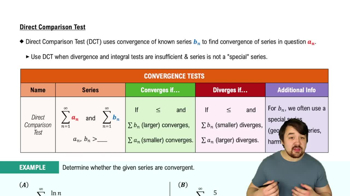
This video solution was recommended by our tutors as helpful for the problem above
Video duration:
5m
Play a video:
0 Comments
Key Concepts
Here are the essential concepts you must grasp in order to answer the question correctly.
Comparison Test for Series Convergence
The Comparison Test helps determine the convergence of a series by comparing it to another series with known behavior. If a series has terms smaller than those of a convergent series, it also converges. Conversely, if its terms are larger than those of a divergent series, it diverges. This test is useful for comparing the speed of convergence between series.
Logarithmic and log-logarithmic series involve terms with logarithmic functions in the denominator, such as ln(k) and ln(ln(k)). These series converge very slowly, and their convergence depends sensitively on the powers of these logarithmic terms. Understanding how these nested logarithms affect term size is key to analyzing convergence rates.
The rate of convergence describes how quickly the partial sums of a series approach the series limit. Series with terms that decrease faster converge more quickly. Comparing terms like 1/(k(ln k)^2) and 1/(k(ln k)(ln ln k)^2) involves analyzing which denominator grows faster, thus indicating which series converges faster.