77–87. Absolute or conditional convergence Determine whether the following series converge absolutely, converge conditionally, or diverge. ∑ (from k = 1 to ∞)(−2)ᵏ⁺¹ / k²
Verified step by step guidance
1
Identify the given series: \( \sum_{k=1}^{\infty} \frac{(-2)^{k+1}}{k^2} \). Notice that the terms involve \((-2)^{k+1}\), which grows exponentially in magnitude, and the denominator \(k^2\), which grows polynomially.
To analyze convergence, first consider the absolute value of the terms: \( \left| \frac{(-2)^{k+1}}{k^2} \right| = \frac{2^{k+1}}{k^2} \). This transforms the series into \( \sum_{k=1}^{\infty} \frac{2^{k+1}}{k^2} \).
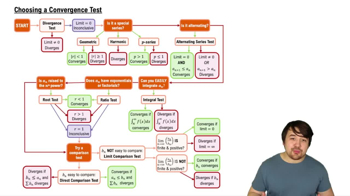
Check for absolute convergence by testing the series \( \sum_{k=1}^{\infty} \frac{2^{k+1}}{k^2} \). Since \(2^{k+1}\) grows exponentially and \(k^2\) grows polynomially, the terms do not approach zero fast enough for convergence. Use the root test or ratio test to confirm this behavior.
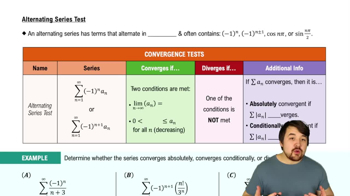
Next, consider conditional convergence by analyzing the original series with alternating signs. However, the factor \((-2)^{k+1}\) does not produce a simple alternating sign pattern because the base is \(-2\), not \(-1\). The terms actually grow in magnitude exponentially, so the series does not satisfy the conditions for the Alternating Series Test.
Conclude that since the series does not converge absolutely (step 3) and does not converge conditionally (step 4), the series diverges.
Verified video answer for a similar problem:
This video solution was recommended by our tutors as helpful for the problem above
Video duration:
5m
Play a video:
0 Comments
Key Concepts
Here are the essential concepts you must grasp in order to answer the question correctly.
Absolute Convergence
A series ∑a_k converges absolutely if the series of absolute values ∑|a_k| converges. Absolute convergence guarantees convergence regardless of the sign of terms, and it implies the original series converges. Testing absolute convergence often involves comparison or p-series tests.
A series converges conditionally if it converges, but does not converge absolutely. This means ∑a_k converges, but ∑|a_k| diverges. Conditional convergence often occurs in alternating series where the terms decrease in magnitude and approach zero.
The Alternating Series Test states that an alternating series ∑(-1)^k b_k converges if the sequence b_k is positive, decreasing, and approaches zero. This test helps determine conditional convergence when absolute convergence fails.