Loglog p-series Consider the series ∑ (k = 2 to ∞) 1 / (k(ln k)(ln ln k)ᵖ), where p is a real number. a. For what values of p does this series converge?
Verified step by step guidance
1
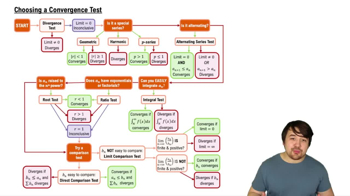
Recognize that the given series is \( \sum_{k=2}^{\infty} \frac{1}{k (\ln k) (\ln \ln k)^p} \), which is a type of log-log p-series. To analyze its convergence, consider using the Integral Test because the terms are positive, continuous, and decreasing for sufficiently large \( k \).
Set up the corresponding integral to apply the Integral Test: \[ \int_2^{\infty} \frac{1}{x (\ln x) (\ln \ln x)^p} \, dx. \] The convergence of this integral will determine the convergence of the series.
Make the substitution \( t = \ln \ln x \). Then, compute \( dt \) in terms of \( dx \): since \( t = \ln(\ln x) \), we have \( dt = \frac{1}{\ln x} \cdot \frac{1}{x} dx \), which implies \( dx = x (\ln x) dt \). This substitution simplifies the integral to \[ \int_{t_0}^{\infty} \frac{1}{t^p} dt, \] where \( t_0 = \ln \ln 2 \).
Analyze the integral \( \int_{t_0}^{\infty} \frac{1}{t^p} dt \). This is a p-type integral, which converges if and only if \( p > 1 \) and diverges otherwise.
Conclude that the original series \( \sum_{k=2}^{\infty} \frac{1}{k (\ln k) (\ln \ln k)^p} \) converges if and only if \( p > 1 \), and diverges for \( p \leq 1 \).
Verified video answer for a similar problem:
This video solution was recommended by our tutors as helpful for the problem above
Video duration:
2m
Play a video:
0 Comments
Key Concepts
Here are the essential concepts you must grasp in order to answer the question correctly.
p-Series and Generalized p-Series
A p-series is a series of the form ∑ 1/n^p, which converges if and only if p > 1. The given series extends this idea by including logarithmic factors in the denominator, requiring an understanding of how these additional terms affect convergence compared to the standard p-series.
The integral test relates the convergence of a series to the convergence of an improper integral of a corresponding function. For positive, decreasing functions, the series ∑ a_k converges if and only if the integral of f(x) from some point to infinity converges. This test is useful for series involving logarithmic terms.
Logarithmic functions like ln(k) and ln(ln(k)) grow slowly, affecting the convergence of series subtly. Understanding how powers of these nested logarithms influence the terms' decay rate is crucial to determining for which values of p the series converges.