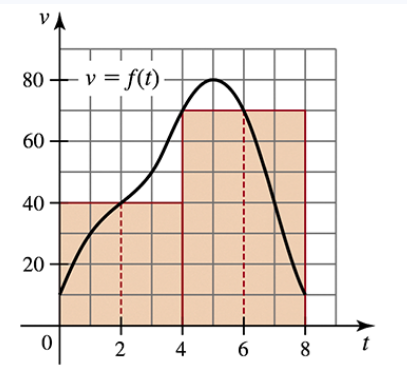
The velocity in ft/s of an object moving along a line is given by v = ƒ(t) on the interval 0 ≤ t ≤ 8 (see figure), where t is measured in seconds. a) Divide the interval [0,8] into n = 2 subintervals, [0,4] and [4,8]. On each subinterval, assume the object moves at a constant velocity equal to the value of v evaluated at the midpoint of the subinterval, and use these approximations to estimate the displacement of the object on [0,8] (see part (a) of the figure)
Verified step by step guidance
1
Step 1: Divide the interval [0,8] into two subintervals: [0,4] and [4,8]. These subintervals are determined based on the problem's requirement to use n = 2 subintervals.
Step 2: Identify the midpoints of each subinterval. For [0,4], the midpoint is t = 2, and for [4,8], the midpoint is t = 6.
Step 3: Evaluate the velocity function v = ƒ(t) at the midpoints. From the graph, v(2) ≈ 40 ft/s and v(6) ≈ 60 ft/s.
Step 4: Calculate the displacement for each subinterval using the formula displacement = velocity × time. For [0,4], displacement ≈ v(2) × (4 - 0) = 40 × 4. For [4,8], displacement ≈ v(6) × (8 - 4) = 60 × 4.
Step 5: Add the displacements from both subintervals to estimate the total displacement of the object on [0,8]. Total displacement ≈ displacement from [0,4] + displacement from [4,8].
Verified video answer for a similar problem:
This video solution was recommended by our tutors as helpful for the problem above
Video duration:
4m
Play a video:
0 Comments
Key Concepts
Here are the essential concepts you must grasp in order to answer the question correctly.
Velocity Function
The velocity function, denoted as v = ƒ(t), describes how the velocity of an object changes over time. In this context, it provides the instantaneous speed of the object at any given time t within the interval [0, 8]. Understanding this function is crucial for estimating displacement, as it directly influences how far the object travels during each time segment.
The Midpoint Rule is a numerical method used to approximate the area under a curve, which in this case represents displacement. By evaluating the velocity at the midpoint of each subinterval, we can assume the object moves at a constant velocity during that interval. This method simplifies calculations and provides a reasonable estimate of total displacement over the entire interval.
Displacement refers to the total distance an object moves in a specific direction over a given time period. In this problem, it is calculated by summing the products of the velocity (evaluated at midpoints) and the duration of each subinterval. Understanding displacement is essential for interpreting the motion of the object and applying the results of the Midpoint Rule effectively.