
Textbook Question
Properties of integrals Consider two functions ƒ and g on [1,6] such that ∫₁⁶ƒ(𝓍) d𝓍 = 10 and ∫₁⁶g(𝓍) d𝓍 = 5, ∫₄⁶ƒ(𝓍) d𝓍 = 5 , and ∫₁⁴g(𝓍) d𝓍 = 2. Evaluate the following integrals.
(a) ∫₁⁴ 3f(𝓍) d𝓍
61
views

 Verified step by step guidance
 10:17
10:17
 06:11 06:11
Properties of integrals Consider two functions ƒ and g on [1,6] such that ∫₁⁶ƒ(𝓍) d𝓍 = 10 and ∫₁⁶g(𝓍) d𝓍 = 5, ∫₄⁶ƒ(𝓍) d𝓍 = 5 , and ∫₁⁴g(𝓍) d𝓍 = 2. Evaluate the following integrals.
(a) ∫₁⁴ 3f(𝓍) d𝓍
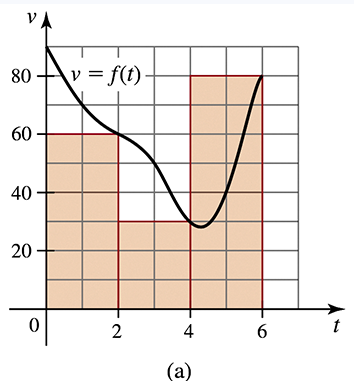
The velocity in ft/s of an object moving along a line is given by v = ƒ(t) on the interval 0 ≤ t ≤ 8 (see figure), where t is measured in seconds.
a) Divide the interval [0,8] into n = 2 subintervals, [0,4] and [4,8]. On each subinterval, assume the object moves at a constant velocity equal to the value of v evaluated at the midpoint of the subinterval, and use these approximations to estimate the displacement of the object on [0,8] (see part (a) of the figure)
Working with area functions Consider the function ƒ and the points a, b, and c.
(a) Find the area function A (𝓍) = ∫ₐˣ ƒ(t) dt using the Fundamental Theorem.
ƒ(𝓍) = ― 12𝓍 (𝓍―1) (𝓍― 2) ; a = 0 , b = 1 , c = 2
Working with area functions Consider the function ƒ and its graph.
(a) Estimate the zeros of the area function A(𝓍) = ∫₀ˣ ƒ(t) dt , for 0 ≤ 𝓍 ≤ 10 .
Sigma notation Express the following sums using sigma notation. (Answers are not unique.)
(a) 1 + 2 + 3 + 4 + 5
Using properties of integrals Use the value of the first integral I to evaluate the two given integrals.
I = ∫₀^π/2 (cos θ ― 2 sin θ) dθ = ―1
(a) ∫₀^π/2 (2 sin θ ― cos θ) dθ