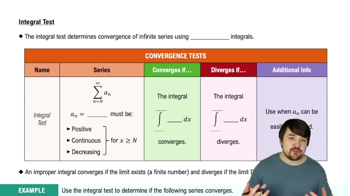
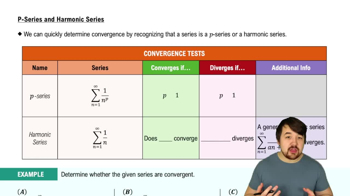
23–38. Divergence, Integral, and p-series Tests Use the Divergence Test, the Integral Test, or the p-series test to determine whether the following series converge. ∑ (k = 1 to ∞) k / eᵏ
Verified step by step guidance
1
Identify the series given: \( \sum_{k=1}^{\infty} \frac{k}{e^{k}} \). Notice that the terms involve \( k \) in the numerator and an exponential \( e^{k} \) in the denominator.
Consider the behavior of the terms \( a_k = \frac{k}{e^{k}} \) as \( k \to \infty \). Since the denominator grows exponentially and the numerator grows linearly, the terms \( a_k \) approach zero, which is a necessary condition for convergence.
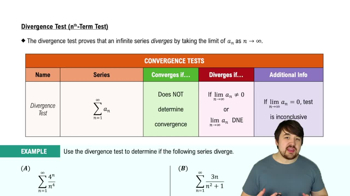
Apply the Divergence Test first: check if \( \lim_{k \to \infty} a_k \neq 0 \). If the limit is not zero, the series diverges. Here, the limit is zero, so the Divergence Test is inconclusive.
Use the Integral Test or compare with a known convergent series. Since \( e^{k} \) grows faster than any polynomial, compare \( \frac{k}{e^{k}} \) to \( \frac{1}{e^{k/2}} \) or recognize it as a series with terms decreasing exponentially.
Conclude that the series converges by comparison to a convergent geometric series or by applying the Integral Test to the function \( f(x) = \frac{x}{e^{x}} \), which is positive, continuous, and decreasing for \( x \geq 1 \).
Verified video answer for a similar problem:
This video solution was recommended by our tutors as helpful for the problem above
Video duration:
3m
Play a video:
0 Comments
Key Concepts
Here are the essential concepts you must grasp in order to answer the question correctly.
Divergence Test
The Divergence Test states that if the limit of the terms of a series does not approach zero, the series diverges. It is a quick initial check to determine if a series cannot converge, but if the limit is zero, the test is inconclusive.
The Integral Test relates the convergence of a series to the convergence of an improper integral of a related function. If the integral of the continuous, positive, decreasing function from which the series terms are derived converges, then the series converges as well.
The p-series Test applies to series of the form ∑ 1/n^p. Such a series converges if and only if p > 1, and diverges otherwise. It is useful for comparing or identifying the behavior of series with terms involving powers of n.