11–86. Applying convergence tests Determine whether the following series converge. Justify your answers. ∑ (from j = 2 to ∞)1 / (j ln¹⁰j)
Verified step by step guidance
1
Identify the series given: \( \sum_{j=2}^{\infty} \frac{1}{j (\ln j)^{10}} \). This is a positive term series, so we can consider convergence tests suitable for positive series.
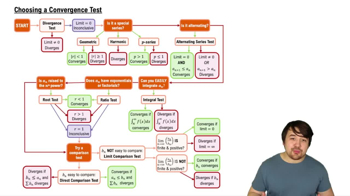
Recognize that the series resembles a p-series with an additional logarithmic factor in the denominator. Since \( j \) grows linearly and \( (\ln j)^{10} \) grows slower than any power of \( j \), we should consider the Integral Test for convergence.
Set up the Integral Test by considering the integral \( \int_{2}^{\infty} \frac{1}{x (\ln x)^{10}} \, dx \). If this improper integral converges, then the series converges; if it diverges, the series diverges.
Make the substitution \( u = \ln x \), which implies \( du = \frac{1}{x} dx \). This transforms the integral into \( \int_{\ln 2}^{\infty} \frac{1}{u^{10}} \, du \).
Evaluate the integral \( \int_{\ln 2}^{\infty} u^{-10} \, du \). Since this is an integral of a power function \( u^{-p} \) with \( p = 10 > 1 \), it converges. Therefore, by the Integral Test, the original series converges.
Verified video answer for a similar problem:
This video solution was recommended by our tutors as helpful for the problem above
Video duration:
8m
Play a video:
0 Comments
Key Concepts
Here are the essential concepts you must grasp in order to answer the question correctly.
Convergence of Infinite Series
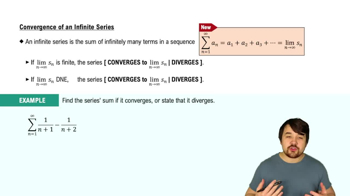
An infinite series converges if the sequence of its partial sums approaches a finite limit. Understanding convergence is essential to determine whether the sum of infinitely many terms results in a finite value or diverges to infinity or oscillates.
The integral test compares a series to an improper integral of a related function. If the integral of f(x) from some point to infinity converges, then the series ∑f(n) also converges, and vice versa. This test is especially useful for series with positive, decreasing terms.
Logarithmic functions grow slowly, and their powers affect convergence rates. In series like ∑ 1/(j (ln j)^p), the exponent p determines convergence: the series converges if p > 1 and diverges if p ≤ 1, highlighting the importance of understanding how logarithmic terms influence series behavior.