Circles in general Show that the polar equation r² - 2r r₀ cos(θ - θ₀) = R² - r₀² describes a circle of radius R whose center has polar coordinates (r₀, θ₀)
Verified step by step guidance
1
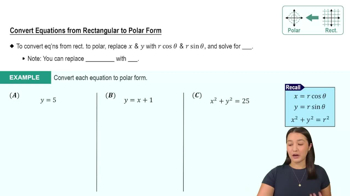
Recall the relationship between polar and Cartesian coordinates: \(x = r \cos\theta\) and \(y = r \sin\theta\). Similarly, the center of the circle has Cartesian coordinates \(x_0 = r_0 \cos\theta_0\) and \(y_0 = r_0 \sin\theta_0\).
Rewrite the given polar equation \(r^2 - 2 r r_0 \cos(\theta - \theta_0) = R^2 - r_0^2\) by expressing \(\cos(\theta - \theta_0)\) using the cosine difference identity: \(\cos(\theta - \theta_0) = \cos\theta \cos\theta_0 + \sin\theta \sin\theta_0\).
Substitute the expressions for \(\cos\theta\) and \(\sin\theta\) in terms of \(x\) and \(y\), and similarly for \(\cos\theta_0\) and \(\sin\theta_0\), to rewrite the equation entirely in terms of \(x\), \(y\), \(x_0\), and \(y_0\).
Simplify the equation to get it into the standard form of a circle: \((x - x_0)^2 + (y - y_0)^2 = R^2\). This will involve expanding and rearranging terms to isolate the squared terms of \((x - x_0)\) and \((y - y_0)\).
Conclude that since the equation matches the standard form of a circle with center \((x_0, y_0)\) and radius \(R\), the original polar equation indeed describes a circle with center at polar coordinates \((r_0, \theta_0)\) and radius \(R\).
Verified video answer for a similar problem:
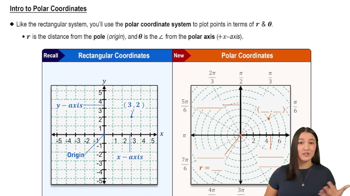
This video solution was recommended by our tutors as helpful for the problem above
Video duration:
4m
Play a video:
0 Comments
Key Concepts
Here are the essential concepts you must grasp in order to answer the question correctly.
Polar Coordinates and Conversion to Cartesian Coordinates
Polar coordinates represent points using a radius and an angle (r, θ). To analyze curves like circles, it is often helpful to convert polar equations into Cartesian form using x = r cos θ and y = r sin θ. This conversion allows the use of familiar geometric interpretations and algebraic manipulations.
A circle with center (h, k) and radius R in Cartesian coordinates satisfies (x - h)² + (y - k)² = R². Recognizing this form after converting from polar coordinates confirms the geometric nature of the curve. Identifying the center and radius from the equation is key to understanding the shape described.
The given polar equation resembles the law of cosines, which relates the lengths of sides in a triangle to the cosine of an included angle. Interpreting r, r₀, and R as sides and θ - θ₀ as the angle helps to understand the geometric meaning of the equation and its relation to a circle centered at (r₀, θ₀).