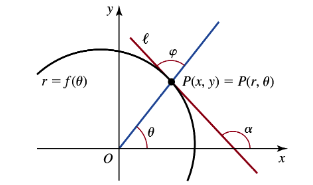
Tangents and normals: Let a polar curve be described by r = f(θ), and let ℓ be the line tangent to the curve at the point P(x,y) = P(r,θ) (see figure). e. Prove that the values of θ for which ℓ is parallel to the y-axis satisfy tan θ = f(θ)/f'(θ).
Verified step by step guidance
1
Recall that the polar coordinates \((r, \theta)\) relate to Cartesian coordinates \((x, y)\) by the equations \(x = r \cos \theta\) and \(y = r \sin \theta\), where \(r = f(\theta)\) for the given curve.
To find the slope of the tangent line \(\ell\) at point \(P\), we need to compute \(\frac{dy}{dx}\). Using the chain rule, express \(\frac{dy}{dx}\) as \(\frac{\frac{dy}{d\theta}}{\frac{dx}{d\theta}}\).
Calculate \(\frac{dx}{d\theta}\) and \(\frac{dy}{d\theta}\) using the product rule:
\(\frac{dx}{d\theta} = f'(\theta) \cos \theta - f(\theta) \sin \theta\),
\(\frac{dy}{d\theta} = f'(\theta) \sin \theta + f(\theta) \cos \theta\).
Substitute these derivatives into the expression for the slope of the tangent line:
\(\frac{dy}{dx} = \frac{f'(\theta) \sin \theta + f(\theta) \cos \theta}{f'(\theta) \cos \theta - f(\theta) \sin \theta}\).
Since the tangent line \(\ell\) is parallel to the y-axis, its slope is undefined, which means the denominator of \(\frac{dy}{dx}\) must be zero:
\(f'(\theta) \cos \theta - f(\theta) \sin \theta = 0\).
Rearranging this gives:
\(f'(\theta) \cos \theta = f(\theta) \sin \theta\),
which leads to
\(\tan \theta = \frac{f(\theta)}{f'(\theta)}\).
This completes the proof.
Verified video answer for a similar problem:
This video solution was recommended by our tutors as helpful for the problem above
Video duration:
5m
Play a video:
0 Comments
Key Concepts
Here are the essential concepts you must grasp in order to answer the question correctly.
Polar Coordinates and Conversion to Cartesian Coordinates
Polar coordinates represent points using a radius r and angle θ, where x = r cos θ and y = r sin θ. Understanding this conversion is essential to relate the polar curve r = f(θ) to Cartesian coordinates (x, y), which helps analyze tangents and normals in the xy-plane.
The slope of the tangent line to a polar curve at a point is given by dy/dx, which can be found using the chain rule: dy/dx = (dy/dθ) / (dx/dθ). This requires differentiating x = r cos θ and y = r sin θ with respect to θ, incorporating both f(θ) and its derivative f'(θ).
A line is parallel to the y-axis if its slope is undefined, meaning dx/dθ = 0 (vertical tangent). Using this condition on the derivatives of x and y with respect to θ leads to the relationship tan θ = f(θ)/f'(θ), which characterizes the angles θ where the tangent line is vertical.