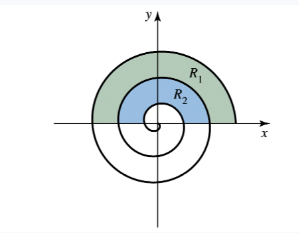
Regions bounded by a spiral: Let Rₙ be the region bounded by the nth turn and the (n+1)st turn of the spiral r = e⁻ᶿ in the first and second quadrants, for θ ≥ 0 (see figure). c. Evaluate lim(n→∞) Aₙ₊₁/Aₙ.
Verified step by step guidance
1
Identify the regions Rₙ as the areas bounded between the nth and (n+1)st turns of the spiral given by \(r = e^{-\theta}\), where \(\theta\) ranges over the first and second quadrants, i.e., \(0 \leq \theta \leq \pi\) for each turn.
Express the area \(A_n\) of the region \(R_n\) using the formula for the area in polar coordinates between two curves or two values of \(\theta\):
\(A_n = \frac{1}{2} \int_{n\pi}^{(n+1)\pi} r^2 \, d\theta\)
Since \(r = e^{-\theta}\), substitute to get
\(A_n = \frac{1}{2} \int_{n\pi}^{(n+1)\pi} e^{-2\theta} \, d\theta\).
Evaluate the integral for \(A_n\):
\(A_n = \frac{1}{2} \left[ \frac{e^{-2\theta}}{-2} \right]_{n\pi}^{(n+1)\pi} = -\frac{1}{4} \left( e^{-2(n+1)\pi} - e^{-2n\pi} \right)\)
Rewrite this as
\(A_n = \frac{1}{4} \left( e^{-2n\pi} - e^{-2(n+1)\pi} \right)\).
Write the expression for the ratio \(\frac{A_{n+1}}{A_n}\):
\(\frac{A_{n+1}}{A_n} = \frac{e^{-2(n+1)\pi} - e^{-2(n+2)\pi}}{e^{-2n\pi} - e^{-2(n+1)\pi}}\)
Factor terms to simplify the ratio, for example, factor out \(e^{-2n\pi}\) in numerator and denominator.
Take the limit as \(n \to \infty\) of the ratio \(\frac{A_{n+1}}{A_n}\) by analyzing the behavior of the exponential terms. Since \(e^{-2n\pi}\) tends to zero as \(n\) grows large, simplify the expression accordingly to find the limit.
Verified video answer for a similar problem:
This video solution was recommended by our tutors as helpful for the problem above
Video duration:
5m
Play a video:
0 Comments
Key Concepts
Here are the essential concepts you must grasp in order to answer the question correctly.
Polar Coordinates and Area Calculation
In polar coordinates, the area of a region bounded by two curves r = f(θ) and r = g(θ) between angles θ = a and θ = b is found using the integral formula A = 1/2 ∫[a to b] (r_outer² - r_inner²) dθ. For a spiral r = e^(-θ), the area between two turns corresponds to integrating over specific θ intervals, which is essential for finding the areas Aₙ.
The spiral r = e^(-θ) involves an exponential decay function. Understanding how e^(-θ) behaves as θ increases helps analyze the shrinking size of the regions Rₙ. Evaluating the limit of the ratio Aₙ₊₁/Aₙ as n approaches infinity requires knowledge of limits and the asymptotic behavior of exponential functions.
The problem involves a sequence of areas {Aₙ} defined by regions between consecutive turns of the spiral. To find lim(n→∞) Aₙ₊₁/Aₙ, one must understand how to express Aₙ in terms of n and then analyze the ratio of consecutive terms. This concept connects integral calculus with sequences and series, focusing on the ratio test and limit evaluation.