First, identify the function y = x(2x + 1)^4. We need to find the second derivative y''.
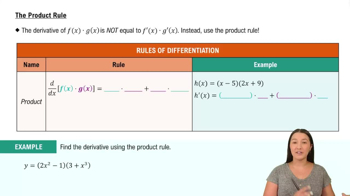
To find the first derivative y', apply the product rule. The product rule states that if you have a function y = u(x)v(x), then y' = u'(x)v(x) + u(x)v'(x). Here, let u(x) = x and v(x) = (2x + 1)^4.
Calculate the derivatives: u'(x) = 1 and v'(x) using the chain rule. For v(x) = (2x + 1)^4, let w = 2x + 1, then v(x) = w^4. The derivative v'(x) = 4w^3 * (dw/dx) = 4(2x + 1)^3 * 2.
Substitute the derivatives back into the product rule: y' = 1 * (2x + 1)^4 + x * 8(2x + 1)^3.
Simplify y' and then find the second derivative y'' by differentiating y' again. Use the product rule and chain rule as necessary to find y''.
Verified video answer for a similar problem:
This video solution was recommended by our tutors as helpful for the problem above
Video duration:
9m
Play a video:
0 Comments
Key Concepts
Here are the essential concepts you must grasp in order to answer the question correctly.
Product Rule
The product rule is a fundamental differentiation rule used when finding the derivative of a product of two functions. If you have two functions u(x) and v(x), the derivative of their product is given by u'(x)v(x) + u(x)v'(x). This rule is essential for differentiating expressions like y = x(2x + 1)⁴, where x is multiplied by another function.
The chain rule is used to differentiate composite functions, where one function is nested inside another. If you have a function y = f(g(x)), the derivative is f'(g(x)) * g'(x). In the given problem, the chain rule helps differentiate the term (2x + 1)⁴, treating it as a composite function with an inner function g(x) = 2x + 1.
The second derivative, denoted as y'', is the derivative of the first derivative y'. It provides information about the curvature or concavity of the function's graph. Calculating the second derivative involves differentiating the first derivative, often requiring the application of differentiation rules like the product and chain rules multiple times.

 9:30 minutes
 Verified step by step guidance
 05:18
05:18