In Exercises 1–12, find the first and second derivatives.
r = 12/θ − 4/θ³ + 1/θ⁴
Verified step by step guidance
1
Step 1: Identify the function for which you need to find the derivatives. The function given is \( r(\theta) = \frac{12}{\theta} - \frac{4}{\theta^3} + \frac{1}{\theta^4} \).
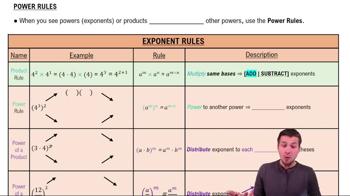
Step 2: Rewrite the function in terms of powers of \( \theta \) to make differentiation easier. This gives \( r(\theta) = 12\theta^{-1} - 4\theta^{-3} + \theta^{-4} \).
Step 3: Find the first derivative \( r'(\theta) \) by applying the power rule \( \frac{d}{d\theta}[\theta^n] = n\theta^{n-1} \) to each term. Differentiate each term separately.
Step 4: Find the second derivative \( r''(\theta) \) by differentiating \( r'(\theta) \) using the power rule again. Apply the rule to each term of the first derivative.
Step 5: Simplify the expressions for both the first and second derivatives to obtain the final forms. Ensure all terms are expressed in terms of \( \theta \) with negative exponents as needed.
Verified video answer for a similar problem:
This video solution was recommended by our tutors as helpful for the problem above
Video duration:
3m
Play a video:
0 Comments
Key Concepts
Here are the essential concepts you must grasp in order to answer the question correctly.
Derivatives
A derivative represents the rate of change of a function with respect to a variable. In calculus, it is a fundamental concept that allows us to determine how a function behaves locally. The first derivative indicates the slope of the tangent line to the curve at any point, while the second derivative provides information about the curvature or concavity of the function.
The chain rule is a formula for computing the derivative of a composite function. It states that if a function y is composed of two functions u and x (i.e., y = f(u) and u = g(x)), then the derivative of y with respect to x is the product of the derivative of f with respect to u and the derivative of g with respect to x. This rule is essential when differentiating functions that involve variables in the denominator, as seen in the given expression.
The power rule is a basic technique for finding the derivative of a function in the form of x^n, where n is any real number. According to this rule, the derivative of x^n is n*x^(n-1). This rule simplifies the process of differentiation, especially for polynomial and rational functions, making it crucial for calculating the first and second derivatives of the given function.

 3:31 minutes
 Verified step by step guidance
 05:44
05:44