7–64. Integration review Evaluate the following integrals. 8. ∫ (9x - 2)^(-3) dx
Verified step by step guidance
1
Step 1: Recognize that the integral involves a power of a linear function, (9x - 2)^(-3). To solve this, use the substitution method. Let u = 9x - 2, which simplifies the expression.
Step 2: Compute the derivative of u with respect to x. Since u = 9x - 2, we find that du/dx = 9, or equivalently, dx = du/9.
Step 3: Rewrite the integral in terms of u. Substituting u and dx into the integral, it becomes ∫ u^(-3) * (1/9) du.
Step 4: Factor out the constant 1/9 from the integral. The integral now simplifies to (1/9) ∫ u^(-3) du.
Step 5: Apply the power rule for integration. Recall that ∫ u^n du = (u^(n+1))/(n+1) for n ≠ -1. Here, n = -3, so the integral becomes (1/9) * (u^(-3+1))/(-3+1). Simplify the expression and substitute back u = 9x - 2 to express the result in terms of x.
Verified video answer for a similar problem:
This video solution was recommended by our tutors as helpful for the problem above
Video duration:
2m
Play a video:
0 Comments
Key Concepts
Here are the essential concepts you must grasp in order to answer the question correctly.
Integration
Integration is a fundamental concept in calculus that involves finding the antiderivative of a function. It is the process of calculating the area under a curve represented by a function over a specified interval. Understanding integration is crucial for evaluating integrals, as it allows us to reverse the process of differentiation.
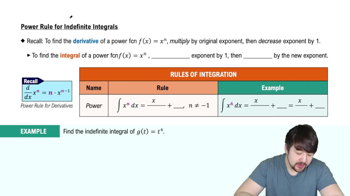
The Power Rule for Integration is a technique used to integrate functions of the form x^n, where n is a real number. According to this rule, the integral of x^n is (x^(n+1))/(n+1) + C, provided n is not equal to -1. This rule is particularly useful when dealing with polynomial expressions and can be adapted for functions involving negative exponents.
The Substitution Method is a technique used in integration to simplify the process by changing variables. It involves substituting a part of the integrand with a new variable, which can make the integral easier to evaluate. This method is especially effective when dealing with composite functions or when the integrand contains a function and its derivative.