24–26. Sets in polar coordinates Sketch the following sets of points.
4 ≤ r² ≤ 9
Verified step by step guidance
1
Understand that the inequality \(4 \leq r^{2} \leq 9\) describes a set of points in polar coordinates where \(r\) is the distance from the origin to the point.
Rewrite the inequality in terms of \(r\) by taking the square root of each part, remembering to consider both positive and negative roots: \(2 \leq r \leq 3\) (since \(r\) represents a radius, we consider only the non-negative values).
Interpret this as all points whose distance from the origin is at least 2 units and at most 3 units, which geometrically represents the region between two circles centered at the origin with radii 2 and 3.
To sketch the set, draw two concentric circles: one with radius 2 and another with radius 3, both centered at the origin.
Shade the annular region (ring-shaped area) between these two circles, as this represents all points satisfying \(4 \leq r^{2} \leq 9\).
Verified video answer for a similar problem:
This video solution was recommended by our tutors as helpful for the problem above
Video duration:
5m
Play a video:
0 Comments
Key Concepts
Here are the essential concepts you must grasp in order to answer the question correctly.
Polar Coordinates System
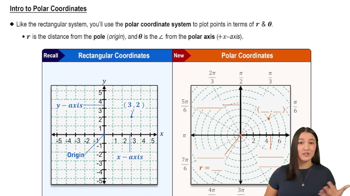
Polar coordinates represent points in a plane using a radius and an angle, denoted as (r, θ). The radius r measures the distance from the origin, and θ is the angle from the positive x-axis. This system is useful for describing curves and regions that are circular or radial in nature.
An inequality like 4 ≤ r² ≤ 9 restricts the radius r to values whose squares lie between 4 and 9. Since r² is always non-negative, this means r lies between 2 and 3, including both boundaries. This defines an annular region (ring-shaped) between two circles centered at the origin.
To sketch sets defined by inequalities in polar coordinates, interpret the conditions on r and θ to identify the region. For 4 ≤ r² ≤ 9, the region is all points whose distance from the origin is between 2 and 3, forming a ring. The angle θ typically ranges over all real numbers unless otherwise restricted.