27–34. Working with sequences Several terms of a sequence {aₙ}ₙ₌₁∞ are given. a. Find the next two terms of the sequence.
{1, 3, 9, 27, 81, ......}
Verified step by step guidance
1
Identify the pattern in the given sequence: {1, 3, 9, 27, 81, ......}. Notice how each term relates to the previous term.
Check if the sequence is geometric by dividing each term by the previous term. For example, calculate \( \frac{3}{1} \), \( \frac{9}{3} \), \( \frac{27}{9} \), and \( \frac{81}{27} \).
If the ratio between consecutive terms is constant, denote this common ratio as \( r \). This means the sequence is geometric and each term can be expressed as \( a_n = a_1 \times r^{n-1} \).
Use the common ratio \( r \) to find the next two terms by multiplying the last known term by \( r \) to get the next term, and then multiply that result by \( r \) again to get the term after that.
Write the expressions for the next two terms as \( a_6 = a_5 \times r \) and \( a_7 = a_6 \times r \), substituting the known values to express these terms explicitly.
Verified video answer for a similar problem:
This video solution was recommended by our tutors as helpful for the problem above
Video duration:
1m
Play a video:
0 Comments
Key Concepts
Here are the essential concepts you must grasp in order to answer the question correctly.
Sequences and Terms
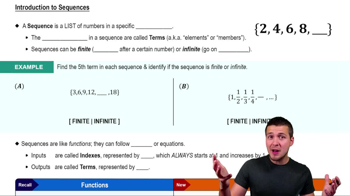
A sequence is an ordered list of numbers following a specific pattern. Each number in the sequence is called a term, typically denoted as aₙ, where n indicates the term's position. Understanding how terms relate helps predict future terms.
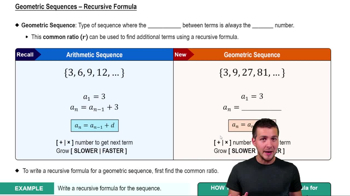
A geometric sequence is one where each term is found by multiplying the previous term by a constant ratio. Identifying this ratio allows you to generate subsequent terms by repeated multiplication.
Recognizing the pattern in a sequence is essential to find missing or future terms. This involves analyzing the given terms, determining the rule (such as addition or multiplication), and applying it to extend the sequence.

 1:54 minutes
 Verified step by step guidance
 8:22
8:22