27–34. Working with sequences Several terms of a sequence {aₙ}ₙ₌₁∞ are given. a. Find the next two terms of the sequence. {1, 2, 4, 8, 16, ......}
Verified step by step guidance
1
Identify the pattern in the given sequence: {1, 2, 4, 8, 16, ......}. Notice how each term relates to the previous term.
Check if the sequence is geometric by dividing each term by the previous term. For example, calculate \( \frac{2}{1} \), \( \frac{4}{2} \), \( \frac{8}{4} \), and \( \frac{16}{8} \).
If the ratio between consecutive terms is constant, denote this common ratio as \( r \). This means the sequence is geometric and each term can be expressed as \( a_n = a_1 \times r^{n-1} \).
Use the formula for the \( n \)-th term of a geometric sequence to find the next terms. Substitute \( n = 6 \) and \( n = 7 \) into \( a_n = a_1 \times r^{n-1} \) to find the 6th and 7th terms.
Write down the next two terms based on the calculations from the previous step, completing the sequence.
Verified video answer for a similar problem:
This video solution was recommended by our tutors as helpful for the problem above
Video duration:
1m
Play a video:
0 Comments
Key Concepts
Here are the essential concepts you must grasp in order to answer the question correctly.
Definition of a Sequence
A sequence is an ordered list of numbers following a specific pattern or rule. Each number in the sequence is called a term, typically denoted as aₙ, where n indicates the term's position. Understanding the pattern helps predict subsequent terms.
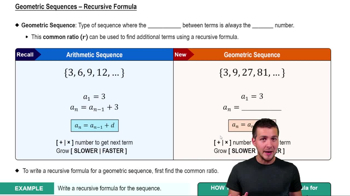
A geometric sequence is one where each term is found by multiplying the previous term by a constant called the common ratio. For example, in the sequence {1, 2, 4, 8, 16, ...}, the common ratio is 2, meaning each term doubles the previous one.
To find the next terms, identify the pattern or rule governing the sequence. For geometric sequences, multiply the last known term by the common ratio. This method allows extending the sequence logically and accurately.

 1:31 minutes
 Verified step by step guidance
 8:22
8:22