42–76. Convergence or divergence Use a convergence test of your choice to determine whether the following series converge. ∑ (from k = 1 to ∞)k! / (eᵏ kᵏ)
Verified step by step guidance
1
Identify the series given: \( \sum_{k=1}^{\infty} \frac{k!}{e^{k} k^{k}} \). We want to determine if this infinite series converges or diverges.
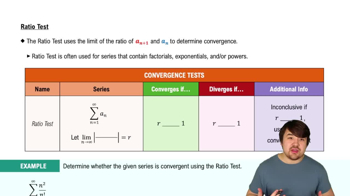
Consider using the Ratio Test, which is often effective for series involving factorials and exponential terms. The Ratio Test states that for \( a_k \), if \( L = \lim_{k \to \infty} \left| \frac{a_{k+1}}{a_k} \right| \), then the series converges if \( L < 1 \), diverges if \( L > 1 \), and is inconclusive if \( L = 1 \).
Write the ratio \( \frac{a_{k+1}}{a_k} \) explicitly: \[ \frac{a_{k+1}}{a_k} = \frac{\frac{(k+1)!}{e^{k+1} (k+1)^{k+1}}}{\frac{k!}{e^{k} k^{k}}} = \frac{(k+1)!}{e^{k+1} (k+1)^{k+1}} \times \frac{e^{k} k^{k}}{k!} \].
Simplify the expression by canceling factorial terms and exponential terms: \( (k+1)! = (k+1) \times k! \) and \( e^{k+1} = e^{k} \times e \). Substitute these to get a simpler form for the ratio.
After simplification, take the limit as \( k \to \infty \) of the ratio. Use properties of limits and approximations such as \( \left(1 + \frac{1}{k}\right)^k \approx e \) to evaluate the limit and determine whether it is less than, greater than, or equal to 1, which will tell you about the convergence or divergence of the series.
Verified video answer for a similar problem:
This video solution was recommended by our tutors as helpful for the problem above
Video duration:
6m
Play a video:
0 Comments
Key Concepts
Here are the essential concepts you must grasp in order to answer the question correctly.
Infinite Series and Convergence
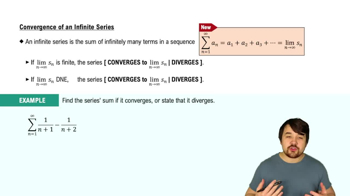
An infinite series is the sum of infinitely many terms. Determining whether such a series converges means checking if the sum approaches a finite limit as the number of terms grows indefinitely. Understanding convergence is essential to analyze the behavior of series like ∑ k! / (e^k k^k).
The Ratio Test is a common method to determine the convergence of a series by examining the limit of the absolute value of the ratio of consecutive terms. If this limit is less than 1, the series converges absolutely; if greater than 1, it diverges. This test is particularly useful for series involving factorials and exponentials.
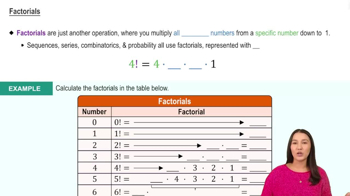
Factorials (k!) grow very rapidly, but so do exponential functions like e^k and powers like k^k. Comparing the growth rates of these terms helps in applying convergence tests effectively. Recognizing how factorials and exponentials behave is crucial for simplifying terms and evaluating limits in series.