23–68. Indefinite integrals Determine the following indefinite integrals. Check your work by differentiation.
∫ (sec² x - 1) dx
Verified step by step guidance
1
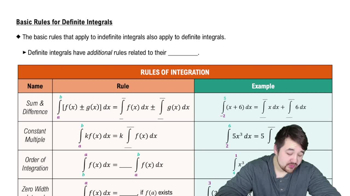
Step 1: Recognize the integral ∫(sec² x - 1) dx as a sum of two separate terms. You can split the integral into ∫sec² x dx - ∫1 dx.
Step 2: Recall the standard integral formula for sec² x. The integral of sec² x is tan(x) + C, where C is the constant of integration.
Step 3: Recall the standard integral formula for 1. The integral of 1 with respect to x is x + C.
Step 4: Combine the results from Step 2 and Step 3. The indefinite integral becomes tan(x) - x + C, where C is the constant of integration.
Step 5: To check your work, differentiate the result tan(x) - x + C. The derivative of tan(x) is sec² x, and the derivative of -x is -1. Adding these together gives sec² x - 1, which matches the original integrand.
Verified video answer for a similar problem:
This video solution was recommended by our tutors as helpful for the problem above
Video duration:
1m
Play a video:
0 Comments
Key Concepts
Here are the essential concepts you must grasp in order to answer the question correctly.
Indefinite Integrals
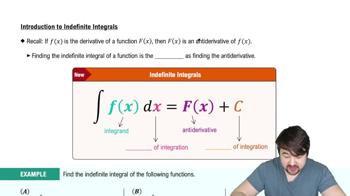
Indefinite integrals represent a family of functions whose derivative is the integrand. They are expressed without limits and include a constant of integration, typically denoted as 'C'. The process of finding an indefinite integral is often referred to as antiderivation, where we seek a function F(x) such that F'(x) equals the integrand.
Basic integration rules are fundamental techniques used to compute integrals. For example, the integral of sec²(x) is a standard result, yielding tan(x) as its antiderivative. Understanding these rules is essential for solving integrals efficiently and accurately, as they provide a foundation for more complex integration techniques.
Verification by differentiation involves checking the correctness of an indefinite integral by differentiating the result. If the derivative of the antiderivative matches the original integrand, the integration is confirmed to be correct. This step is crucial in calculus to ensure that the integration process has been performed accurately.