Evaluating integrals Evaluate the following integrals. ∫ y² /(y³ + 27) dy
Verified step by step guidance
1
Step 1: Recognize that the integral involves a rational function with a cubic polynomial in the denominator. This suggests that partial fraction decomposition or substitution might be useful.
Step 2: Observe that the denominator y³ + 27 can be factored using the sum of cubes formula: y³ + 27 = (y + 3)(y² - 3y + 9).
Step 3: Rewrite the integral as ∫ y² / [(y + 3)(y² - 3y + 9)] dy. At this point, consider substitution to simplify the integral.
Step 4: Let u = y³ + 27, so that du = 3y² dy. This substitution simplifies the integral to (1/3) ∫ du / u.
Step 5: Solve the simplified integral (1/3) ∫ du / u, which is a standard logarithmic integral. The result will involve ln|u| + C, where u = y³ + 27.
Verified video answer for a similar problem:
This video solution was recommended by our tutors as helpful for the problem above
Video duration:
2m
Play a video:
0 Comments
Key Concepts
Here are the essential concepts you must grasp in order to answer the question correctly.
Integration
Integration is a fundamental concept in calculus that involves finding the integral of a function, which represents the area under the curve of that function on a given interval. It can be understood as the reverse process of differentiation. There are various techniques for integration, including substitution, integration by parts, and partial fractions, each suited for different types of integrands.
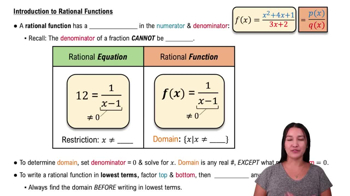
A rational function is a function that can be expressed as the ratio of two polynomials. In the context of integration, rational functions often require specific techniques for integration, such as partial fraction decomposition, which breaks down complex fractions into simpler components that are easier to integrate. Understanding the behavior of rational functions is crucial for evaluating their integrals.
The substitution method is a technique used in integration to simplify the integrand by changing variables. This method involves substituting a part of the integral with a new variable, which can make the integral easier to evaluate. It is particularly useful when dealing with composite functions or when the integrand contains a function and its derivative.