Geometric sums Evaluate the geometric sums ∑ (from k = 0 to 9) (0.2)ᵏand∑ (from k = 2 to 9) (0.2)ᵏ.
Verified step by step guidance
1
Recognize that both sums are geometric series where each term is of the form \(r^k\) with common ratio \(r = 0.2\).
Recall the formula for the sum of the first \(n+1\) terms of a geometric series starting at \(k=0\): \(S = \frac{1 - r^{n+1}}{1 - r}\).
For the first sum \(\sum_{k=0}^{9} (0.2)^k\), identify \(n=9\) and apply the formula: \(S_1 = \frac{1 - (0.2)^{10}}{1 - 0.2}\).
For the second sum \(\sum_{k=2}^{9} (0.2)^k\), express it as the difference between the sum from \(k=0\) to \(9\) and the sum from \(k=0\) to \(1\): \(S_2 = \sum_{k=0}^{9} (0.2)^k - \sum_{k=0}^{1} (0.2)^k\).
Calculate \(\sum_{k=0}^{1} (0.2)^k\) using the geometric sum formula with \(n=1\): \(S_{0\text{ to }1} = \frac{1 - (0.2)^2}{1 - 0.2}\), then subtract this from \(S_1\) to find \(S_2\).
Verified video answer for a similar problem:
This video solution was recommended by our tutors as helpful for the problem above
Video duration:
3m
Play a video:
0 Comments
Key Concepts
Here are the essential concepts you must grasp in order to answer the question correctly.
Geometric Series
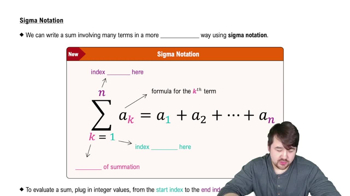
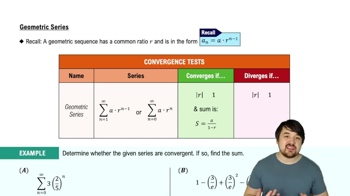
A geometric series is the sum of terms where each term is found by multiplying the previous term by a constant ratio. It has the form ∑ ar^k, where a is the first term and r is the common ratio. Understanding this structure is essential for evaluating sums like those given.
The sum of the first n+1 terms of a geometric series is given by S = a(1 - r^(n+1)) / (1 - r), where a is the first term and r is the common ratio (r ≠ 1). This formula allows quick calculation of sums without adding each term individually.
When the summation index does not start at zero, it is often helpful to rewrite the sum by shifting the index to start at zero. This simplifies applying the geometric series formula by adjusting the first term and the number of terms accordingly.

 3:42 minutes
 Verified step by step guidance
 06:00
06:00