21–42. Geometric series Evaluate each geometric series or state that it diverges.
37.1 + e/π + e²/π² + e³/π³ + ⋯
Verified step by step guidance
1
Identify the first term \( a \) of the geometric series. Here, the first term is \( 1 \).
Determine the common ratio \( r \) by dividing the second term by the first term: \( r = \frac{e/\pi}{1} = \frac{e}{\pi} \).
Check the convergence of the series by evaluating the absolute value of the common ratio \( |r| = \left| \frac{e}{\pi} \right| \). The series converges if \( |r| < 1 \) and diverges otherwise.
If the series converges, use the formula for the sum of an infinite geometric series: \[ S = \frac{a}{1 - r} \], where \( a \) is the first term and \( r \) is the common ratio.
Substitute the values of \( a \) and \( r \) into the formula to express the sum of the series.
Verified video answer for a similar problem:
This video solution was recommended by our tutors as helpful for the problem above
Video duration:
1m
Play a video:
0 Comments
Key Concepts
Here are the essential concepts you must grasp in order to answer the question correctly.
Geometric Series
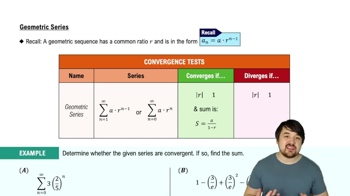
A geometric series is a sum of terms where each term is found by multiplying the previous term by a constant ratio. It has the form a + ar + ar² + ar³ + ⋯, where a is the first term and r is the common ratio.
A geometric series converges if the absolute value of the common ratio |r| is less than 1. When it converges, the sum can be calculated using the formula S = a / (1 - r). If |r| ≥ 1, the series diverges and does not have a finite sum.
To evaluate the series 1 + e/π + e²/π² + ⋯, identify the first term a = 1 and the common ratio r = e/π. Since e ≈ 2.718 and π ≈ 3.1415, |r| < 1, so the series converges. Use the sum formula S = 1 / (1 - e/π) to find the sum.

 1:43 minutes
 Verified step by step guidance
 06:00
06:00