61–66. Sequences of partial sums For the following infinite series, find the first four terms of the sequence of partial sums. Then make a conjecture about the value of the infinite series or state that the series diverges.
4 + 0.9 + 0.09 + 0.009 + ⋯
Verified step by step guidance
1
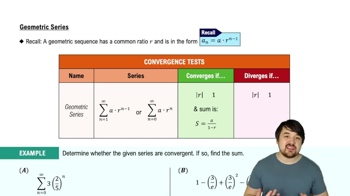
Identify the given infinite series: 4 + 0.9 + 0.09 + 0.009 + \(\cdots\). Notice that each term after the first is obtained by multiplying the previous term by 0.1, so this is a geometric series.
Write the first four terms explicitly: \(a_1 = 4\), \(a_2 = 0.9\), \(a_3 = 0.09\), and \(a_4 = 0.009\).
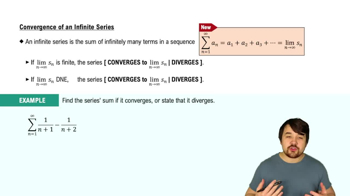
Calculate the first four partial sums \(S_n\), where \(S_n = a_1 + a_2 + \cdots + a_n\). So, \(S_1 = 4\), \(S_2 = 4 + 0.9\), \(S_3 = 4 + 0.9 + 0.09\), and \(S_4 = 4 + 0.9 + 0.09 + 0.009\).
Recognize that since this is a geometric series with first term \(a = 4\) and common ratio \(r = 0.1\), the sum of the first \(n\) terms can be expressed as \(S_n = a \frac{1 - r^n}{1 - r}\).
To conjecture the value of the infinite series, consider the limit of \(S_n\) as \(n \to \infty\). Since \(|r| < 1\), the infinite sum converges to \(S = \frac{a}{1 - r}\).
Verified video answer for a similar problem:
This video solution was recommended by our tutors as helpful for the problem above
Video duration:
3m
Play a video:
0 Comments
Key Concepts
Here are the essential concepts you must grasp in order to answer the question correctly.
Sequence of Partial Sums
A sequence of partial sums is formed by adding the terms of a series one by one. For an infinite series, the nth partial sum is the sum of the first n terms. Studying these sums helps determine whether the series converges to a finite value or diverges.
A geometric series is a series where each term is found by multiplying the previous term by a constant ratio. Its partial sums have a specific formula, and if the absolute value of the ratio is less than one, the series converges to a finite limit.
A series converges if its sequence of partial sums approaches a finite limit as the number of terms grows. If the partial sums grow without bound or oscillate indefinitely, the series diverges. Determining convergence is key to understanding the behavior of infinite series.

 3:18 minutes
 Verified step by step guidance
 8:22
8:22