84. Arc length for polar curves: Prove that the length of the curve r = f(θ) for α ≤ θ ≤ β is L = ∫(α to β) √(f(θ)² + f'(θ)²) dθ.
Verified step by step guidance
1
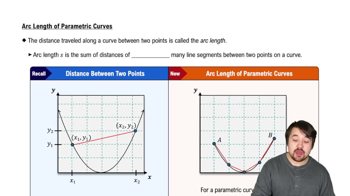
Recall the formula for the arc length of a curve given in Cartesian coordinates: if a curve is parameterized by \( x(t) \) and \( y(t) \) for \( t \) in \( [a, b] \), then the arc length \( L \) is \( L = \int_a^b \sqrt{\left(\frac{dx}{dt}\right)^2 + \left(\frac{dy}{dt}\right)^2} \, dt \).
Express the polar curve \( r = f(\theta) \) in Cartesian coordinates using the relationships \( x = r \cos \theta = f(\theta) \cos \theta \) and \( y = r \sin \theta = f(\theta) \sin \theta \).
Compute the derivatives \( \frac{dx}{d\theta} \) and \( \frac{dy}{d\theta} \) using the product rule: \( \frac{dx}{d\theta} = f'(\theta) \cos \theta - f(\theta) \sin \theta \) and \( \frac{dy}{d\theta} = f'(\theta) \sin \theta + f(\theta) \cos \theta \).
Substitute these derivatives into the arc length formula: \( L = \int_\alpha^\beta \sqrt{\left(f'(\theta) \cos \theta - f(\theta) \sin \theta\right)^2 + \left(f'(\theta) \sin \theta + f(\theta) \cos \theta\right)^2} \, d\theta \).
Simplify the expression inside the square root by expanding and combining like terms, using the Pythagorean identity \( \sin^2 \theta + \cos^2 \theta = 1 \), to show that it reduces to \( \sqrt{f'(\theta)^2 + f(\theta)^2} \), thus proving the formula \( L = \int_\alpha^\beta \sqrt{f(\theta)^2 + f'(\theta)^2} \, d\theta \).
Verified video answer for a similar problem:
This video solution was recommended by our tutors as helpful for the problem above
Video duration:
4m
Play a video:
0 Comments
Key Concepts
Here are the essential concepts you must grasp in order to answer the question correctly.
Polar Coordinates and Curves
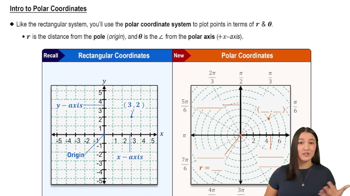
Polar coordinates represent points in the plane using a radius and an angle (r, θ). A polar curve is defined by a function r = f(θ), describing how the radius changes with the angle. Understanding this system is essential to relate the curve's shape to its parametric form.
The arc length of a curve defined parametrically by x(t) and y(t) from t = a to b is given by the integral of the square root of (dx/dt)² + (dy/dt)² dt. This formula generalizes the distance traveled along a curve and is the foundation for deriving arc length in polar form.
Differentiation and Chain Rule in Polar Coordinates
To find the arc length of a polar curve, one must differentiate r = f(θ) and convert the curve into parametric form x = r cos θ, y = r sin θ. Applying the chain rule to these expressions allows computation of dx/dθ and dy/dθ, which are used in the arc length integral.