Is it possible for an alternating series to converge absolutely but not conditionally?
Verified step by step guidance
1
Recall the definitions: An alternating series is a series whose terms alternate in sign, typically written as \(\sum (-1)^n a_n\) with \(a_n > 0\). Absolute convergence means \(\sum |a_n|\) converges, while conditional convergence means \(\sum a_n\) converges but \(\sum |a_n|\) diverges.
Understand the relationship between absolute and conditional convergence: If a series converges absolutely, it means the series of absolute values converges. This implies the original series also converges (since absolute convergence is a stronger condition).
Analyze the question: Can an alternating series converge absolutely but not conditionally? Since absolute convergence implies convergence of the original series, the original series must also converge. Therefore, if it converges absolutely, it automatically converges (not just conditionally, but unconditionally).
Conclude that an alternating series cannot converge absolutely but fail to converge conditionally, because absolute convergence guarantees convergence of the original series, making conditional convergence irrelevant in that case.
Summarize: Absolute convergence implies convergence of the original series, so an alternating series that converges absolutely also converges (not just conditionally). Hence, it is not possible for an alternating series to converge absolutely but not conditionally.
Verified video answer for a similar problem:
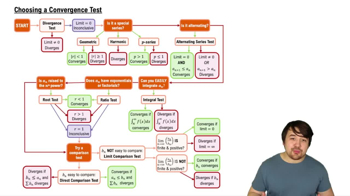
This video solution was recommended by our tutors as helpful for the problem above
Video duration:
4m
Play a video:
0 Comments
Key Concepts
Here are the essential concepts you must grasp in order to answer the question correctly.
Absolute Convergence
Absolute convergence occurs when the series formed by taking the absolute values of the terms converges. If a series ∑a_n converges absolutely, then ∑|a_n| also converges, which implies strong convergence properties and guarantees the original series converges regardless of term order.
Conditional convergence happens when a series ∑a_n converges, but the series of absolute values ∑|a_n| diverges. This means the series converges only due to the alternating signs or specific arrangement of terms, and rearranging terms can affect the sum.
Relationship Between Absolute and Conditional Convergence
If a series converges absolutely, it must also converge (not just conditionally). Therefore, it is impossible for a series to converge absolutely but not conditionally. Absolute convergence is a stronger condition that implies convergence without relying on sign alternation.